Special Order - allow 2+ weeks lead
Couldn't load pickup availability
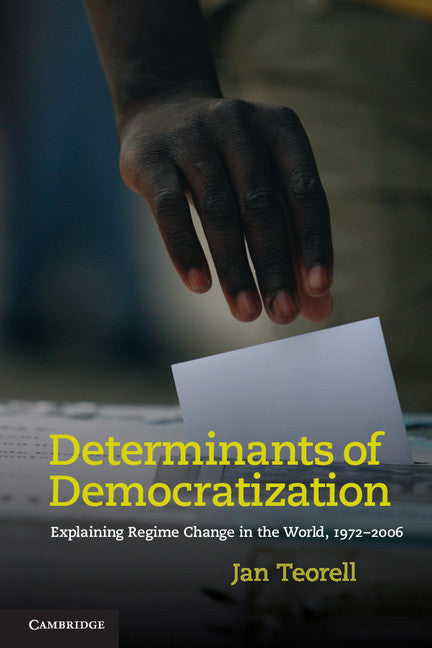
Determinants of Democratization
Explaining Regime Change in the World, 1972–2006
A new explanation of the wave of democratization that has swept the world over the last few decades.
Jan Teorell (Author)
9780521139687, Cambridge University Press
Paperback / softback, published 28 October 2010
222 pages, 12 b/w illus. 19 tables
22.6 x 15.2 x 1.5 cm, 0.32 kg
'… there is no doubt that Teorell's book makes a major contribution to the already crowded field of democratization studies. The theoretical and empirical ground covered is breath-taking and in their combination with high methodological sophistication and various conceptual innovations, such as the intriguing operationalization of pathway cases and the distinction between upturns and downturn, are outstanding. His book should be considered a must-read for democratization and multi-method scholars alike.' Acta Politica
What are the determinants of democratization? Do the factors that move countries toward democracy also help them refrain from backsliding toward autocracy? This book attempts to answer these questions through a combination of a statistical analysis of social, economic, and international determinants of regime change in 165 countries around the world in 1972–2006, and case study work on nine episodes of democratization occurring in Argentina, Bolivia, Hungary, Nepal, Peru, the Philippines, South Africa, Turkey, and Uruguay. The findings suggest that democracy is promoted by long-term structural forces such as economic prosperity, but also by peaceful popular uprisings and the institutional setup of authoritarian regimes. In the short-run, however, elite actors may play a key role, particularly through the importance of intra-regime splits. Jan Teorell argues that these results have important repercussions both for current theories of democratization and for the international community's effort in developing policies for democracy promotion.
Introduction
1. Explaining democratization
2. The shadow of the past: social determinants
3. The power of prosperity: economic determinants
4. The impetus from abroad: international determinants
5. The force from below: popular mobilization
6. Exogenous shocks and authoritarian regime types: institutional contingency
7. Conclusions
Appendix A. Data and variable definitions
Appendix B. Statistical model
Appendix C. Robustness tests
Appendix D. The pathway criterion.
Subject Areas: International relations [JPS], Political structures: democracy [JPHV], Comparative politics [JPB], Politics & government [JP], Sociology [JHB]