Freshly Printed - allow 8 days lead
Couldn't load pickup availability
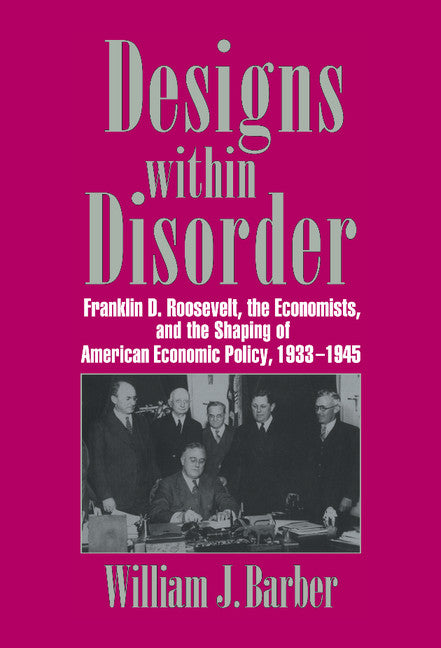
Designs within Disorder
Franklin D. Roosevelt, the Economists, and the Shaping of American Economic Policy, 1933–1945
This 1996 book explains how economists helped to shape the American economy during the years of the New Deal and the Second World War.
William J. Barber (Author)
9780521560788, Cambridge University Press
Hardback, published 28 June 1996
192 pages
22.9 x 15.2 x 1.4 cm, 0.45 kg
'A society that grants enormous authority to economists in government had better pay attention to what and how they think. In this fine study, one of our leading historians of economic thought, William Barber, cuts to the core of the connection between economic knowledge and public policy during the New Deal. Barber shows how the dream of a full-fledged 'Fisc' to match the 'Fed' was blighted, and his emphasis on 'economic learning' - theoretical breakthroughs achieved experimentally, through the deliberative processes of governance - adds an important dimension to the typical new institutionalist preoccupation with structural constraints such as federalism. Barber;s shrewd observations about the not-so-positive implications for today of the low-savings, high-consumption lessons the Keynesians taught are thought-provoking. In all, this is an important book for all those interested in the critical debates that shaped the course of modern liberalism.' Mary O. Furner, University of California, Santa Barbara
More than any of his predecessors in the White House, Franklin D. Roosevelt drew heavily on the thinking of economists as he sought to combat the Great Depression, to mobilize the American economy for war, and to chart a new order for the post-war world. Designs Within Disorder, published in 1996, is an inquiry into the way divergent analytic perspectives competed for official favour and the manner in which the President opted to pick and choose among them when formulating economic policies. During the Roosevelt years, two 'revolutions' were underway simultaneously. One of them involved a fundamental restructuring of the American economy and of the role government was to play in it. A second was an intellectual revolution which engaged economists in reconceptualizing the nature of their discipline. Most of the programmatic initiatives Roosevelt put in place displayed a remarkable staying power for over half a century.
Preface
Guide to abbreviations in citations of sources
Prologue
1. Stage setting in the presidential campaign of 1932
2. Curtain raising in the first hundred days
3. Deployments in the second half of 1933
4. Rethinking the structuralist agenda (I): the fate of NRA, 1934–5
5. Rethinking the structuralist agenda (II): the fate of the Agricultural Adjustment Administration, 1934-6
6. Rethinking macroeconomic strategies, 1934–6
7. Shock tremors and their repercussions, 1937–8
8. Toward a new 'official model,' 1939–40
9. Designs for the management of an economy at war
10. Designs for the postwar world
Epilogue
Bibliographical note
Index.
Subject Areas: Political economy [KCP]