Special Order - allow 2+ weeks lead
Couldn't load pickup availability
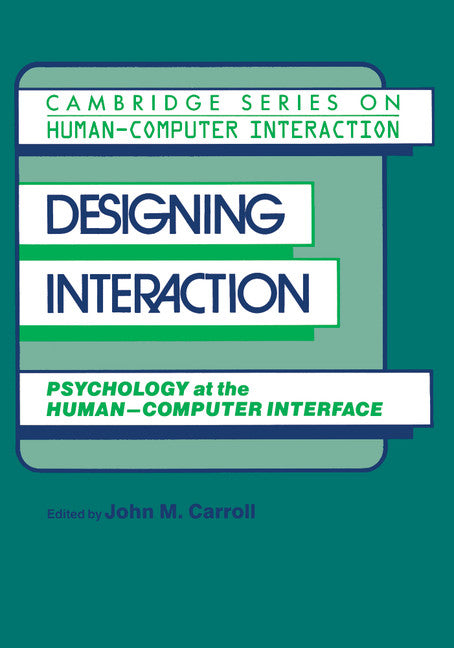
Designing Interaction
Psychology at the Human-Computer Interface
Designing Interaction, first published in 1991, presents a broadbased and fundamental re-examination of human-computer interaction as a practical and scientific endeavor.
John Millar Carroll (Edited by)
9780521409216, Cambridge University Press
Paperback / softback, published 28 June 1991
346 pages
25.2 x 17.9 x 1.8 cm, 0.77 kg
Designing Interaction, first published in 1991, presents a broadbased and fundamental re-examination of human-computer interaction as a practical and scientific endeavor. The chapters in this well-integrated, tightly focused book are by psychologists and computer scientists in industry and academia, who examine the relationship between contemporary psychology and human-computer interaction. HCI seeks to produce user interfaces that facilitate and enrich human motivation, action and experience; but to do so deliberately it must also incorporate means of understanding user interfaces in human terms - the province of psychology. Conversely, the design and use of computing equipment provides psychologists with a diverse and challenging empirical field in which to assess their theories and methodologies.
Preface
Contributors
1. Introduction: The Kittle House Manifesto John M. Carroll
2. Cognitive artifacts Donald A. Norman
3. Some remarks on the theory-practice gap Zenon W. Pylyshyn
4. Comparative task analysis: an alternative direction for human-computer interaction science Ruven Brooks
5. Let's get real: a position paper on the role of cognitive psychology in the design of humanly useful and usable systems Thomas K. Landauer
6. The task-artifact cycle John M. Carroll, Wendy A. Kellogg and Mary Beth Rosson
7. Bridging between basic theories and the artifacts of human-computer interaction Philip Barnard
8. Interface problems and interface resources Stephen J. Payne
9. Inner and outer theory in human-computer interaction Clayton Lewis
10. Local sciences: viewing the design of human-computer systems as cognitive science Andrea A. diSessa
11. The role of German work psychology in the design of artifacts Siegfried Greif
12. Beyond the interface: encountering artifacts in use Liam J. Bannon and Susanne Bødker
13. A development perspective on interface, design and theory Austin Henderson
14. Working with the design process: supporting effective and efficient design John Karat and John L. Bennett
15. Discussion: perspectives on methodology in HCI research and practice Linda Tetzlaff and Robert L. Mack
Index.
Subject Areas: Human-computer interaction [UYZ], Cognition & cognitive psychology [JMR]