Freshly Printed - allow 7 days lead
Couldn't load pickup availability
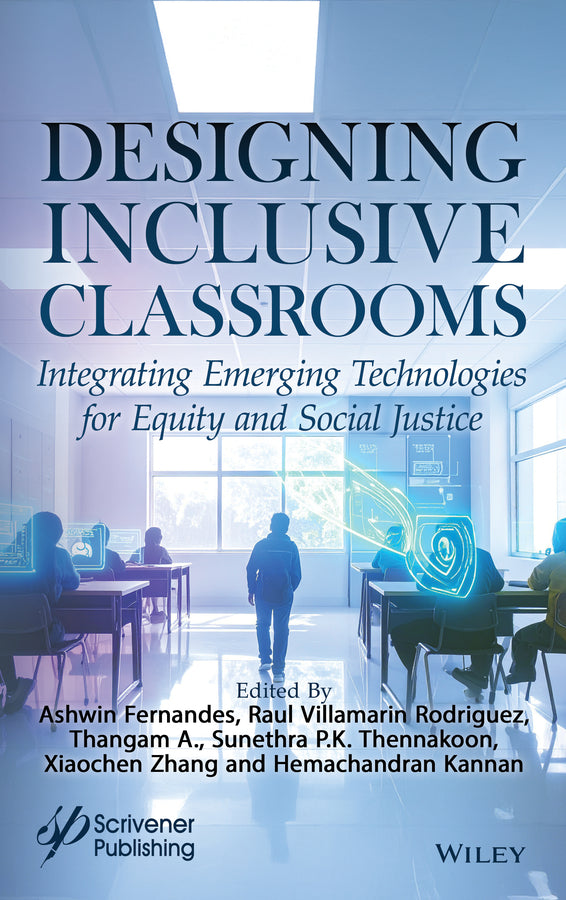
Designing Inclusive Classrooms
Integrating Emerging Technologies
Ashwin Fernandes (Edited by), Raul Villamarin Rodriguez (Edited by), Thangam A. (Edited by), Sunethra Pushpa Kumari Thennakoon (Edited by), Xiaochen Zhang (Edited by), Hemachandran Kannan (Edited by)
9781394389193, Wiley
Hardback, published 4 March 2026
400 pages
22.9 x 15.2 x 2.5 cm, 0.794 kg
Designing Inclusive Classrooms Recently, both the education and technology fields have acknowledged a rising awareness that traditional teaching practices, curricula, and institutional policies can frequently uphold inequalities. These disparities have a greater impact on students belonging to marginalized communities, such as low-income backgrounds, students with disabilities, and racial and ethnic minorities. The global transition to digital and online learning has worsened this problem, highlighting disparities in access and inclusivity. This book will serve as a comprehensive reference for understanding how to create equitable and socially just learning environments by leveraging emerging technologies. The book will cover a wide range of topics, from foundational theories of equity and justice in education to practical applications of cutting-edge technologies such as artificial intelligence, virtual reality, and digital learning platforms. It will provide both a conceptual framework and actionable strategies for designing classrooms that meet the diverse needs of students while promoting fairness, inclusivity, and engagement. In addition to practical guidance, the book will critically examine the challenges and ethical considerations of using technology in the pursuit of equity and social justice. This book will serve as an invaluable resource across the fields of education and technology to create a more equitable future.
List of Contributors xxiii 1 Revolutionizing Education: Emerging Technologies in Education to Transforming Learning for the Future and Their Impact on Learning 1 2 Addressing Algorithmic Bias in Education Technologies 37 3 Assistive Technologies for Students with Disabilities 55 4 Building Inclusive Online Learning Communities 81 5 Democracy: A Key Facilitator in Integrating Artificial Intelligence and Inclusion in the Classroom 105 6 Digital Solutions for Fostering Educational Equity & Social Justice: An Analysis from Indian Perspective 121 7 AI-Driven Personalized Learning: A Pathway to Equity and Social Justice 137 8 Immersive VR and AR Technologies for Inclusive Classrooms to Bridge Equity Gaps and Promote Social Justice 155 9 Overview of Emerging Technologies in Education 181 10 Evaluating the Impact of Emerging Technologies on Equity 203 11 AI Technologies for Social Justice and Equity in Design Classroom Inclusive 239 12 Designing Gamified Classrooms for Technological Equity and Inclusion 259 13 Universal Design for Learning (UDL) and Inclusive Pedagogy 279 14 AI in Financial Fraud Detection and Prevention 295 15 Emerging Technologies in Education: Transforming Learning through Innovation 329 Bibliography 352
Preface xxix
Ram Singh, Vijaylakshmi, Parveen Bala, Jyotirmoy Banerje and Naznin
Ameera Aafreen Quadeer Khan, Venkat Yellamelli, Bazzuri Nikhil Reddy and Anil Pise
Divya Nair, Arin Baby and Colin Barthalome
Challa Sai Yaswitha, Meka Venkata Siva Sahith and Tarun Sai Manoj
Naznin and Sachin Chauhan
Puranjoy Ghosh and Shrilekha Banerjee
Sachin Sharma
Nidhi Sutar, Dinesh Kumar, Balkar Punia and Hamed Taherdoost
Ramchandra Alias Ameet Chate, Ganesh R. Chate, Gourav V. Kulkarni, Uttam U. Deshpande, Vaibhav R. Chate and Raviraj M. Kulkarni
Nelsonmandela S.
Kande Archana, Kamakshi Prasad and M. Ashok
Balasubramania Raja G. and Nelsonmandela S.
Revathi T. and Chinna Swamy Dudekula
Shaik Valli Haseena, Neha Jasawani, Ayasha, Gaikwad Beena Suresh and Simna Shanavas
Devendran A., M. Vijaykumar, R. Jayam, K. Arunkumar and Gabriel Kabanda
About the Editors 353
Index 355
Subject Areas: Computer science [UY]