Freshly Printed - allow 6 days lead
Couldn't load pickup availability
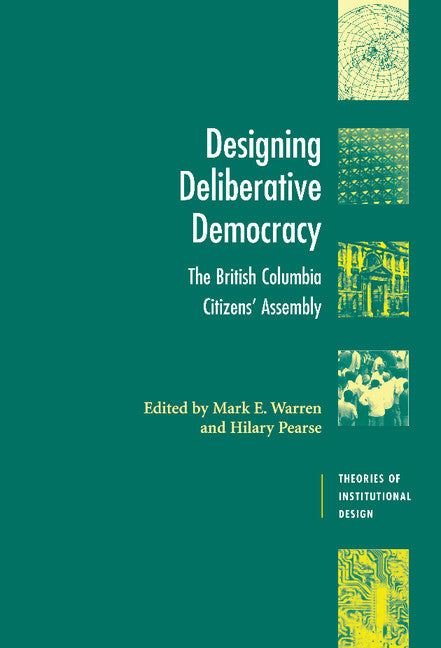
Designing Deliberative Democracy
The British Columbia Citizens' Assembly
The first authoritative assessment of a unique application of deliberative democracy.
Mark E. Warren (Edited by), Hilary Pearse (Edited by)
9780521885072, Cambridge University Press
Hardback, published 7 February 2008
252 pages, 4 b/w illus. 20 tables
23.4 x 15.3 x 2.1 cm, 0.54 kg
'British Columbia's Citizens Assembly was a unique and important experiment in citizen political participation and democratic reform. Designing Deliberative Democracy provides a very rich account of the process from the perspective of the participants, the general public and democratic theory. This book presents convincing evidence of the quality of the CA's deliberations and draws out the important implications for our theories of deliberative democracy.' Russell J. Dalton, University of California, Irvine
Is it possible to advance democracy by empowering ordinary citizens to make key decisions about the design of political institutions and policies? In 2004, the government of British Columbia embarked on a bold democratic experiment: it created an assembly of 160 near-randomly selected citizens to assess and redesign the province's electoral system. The British Columbia Citizens' Assembly represents the first time a citizen body has had the power to reform fundamental political institutions. It was an innovative gamble that has been replicated elsewhere in Canada and in the Netherlands, and is gaining increasing attention in Europe as a democratic alternative for constitution-making and constitutional reform. In the USA, advocates view citizens' assemblies as a means for reforming referendum processes. This book investigates the citizens' assembly in British Columbia to test and refine key propositions of democratic theory and practice.
Introduction: democratic renewal and deliberative democracy Mark E. Warren and Hilary Pearse
1. Who should govern who governs? The role of citizens in reforming the electoral system Dennis F. Thompson
2. Citizen representatives Mark E. Warren
3. Institutional design and citizen deliberation Hilary Pearse
4. Agenda setting in deliberative forums: expert influence and citizen autonomy in the British Columbia Citizens' Assembly Amy Lang
5. Descriptive representation in the British Columbia Citizens' Assembly Michael Rabinder James
6. Do citizens' assemblies make reasoned choices? André Blais, R. Kenneth Carty and Patrick Fournier
7. Communicative rationality in the Citizens' Assembly and referendum process R. S. Ratner
8. Deliberation, information and trust: the British Columbia Citizens' Assembly as agenda setter Fred Cutler, Richard Johnston, R. Kenneth Carty, André Blais and Patrick Fournier
Conclusion: the citizens' assembly model John Ferejohn.
Subject Areas: Political economy [KCP], Comparative politics [JPB], Political science & theory [JPA], Social & political philosophy [HPS]