Freshly Printed - allow 7 days lead
Couldn't load pickup availability
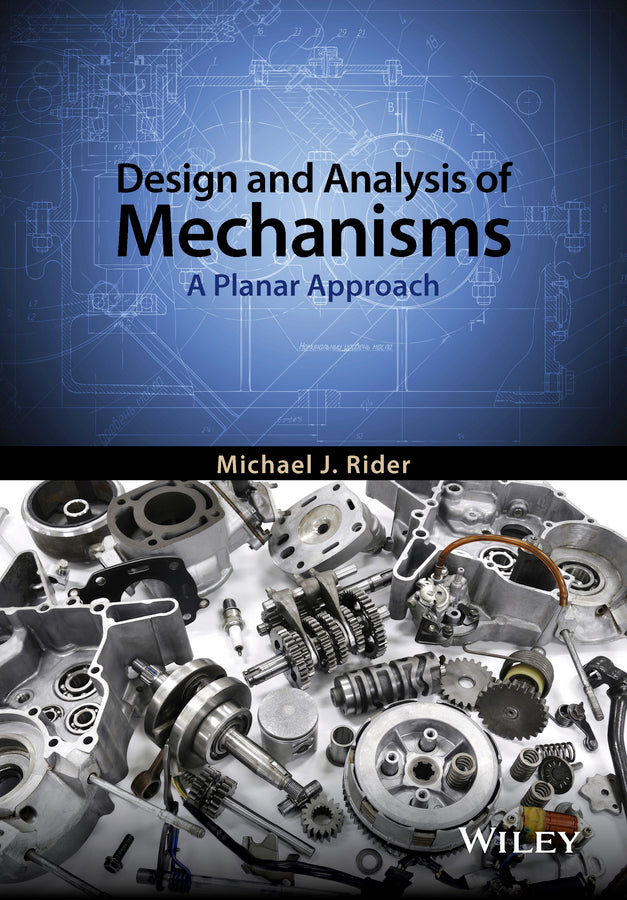
Design and Analysis of Mechanisms
A Planar Approach
Michael J. Rider (Author)
9781119054337, Wiley
Paperback / softback, published 10 July 2015
320 pages
24.5 x 16.9 x 1.4 cm, 0.494 kg
A planar or two-dimensional (2D) mechanism is the combination of two or more machine elements that are designed to convey a force or motion across parallel planes. For any mechanical engineer, young or old, an understanding of planar mechanism design is fundamental. Mechanical components and complex machines, such as engines or robots, are often designed and conceptualised in 2D before being extended into 3D. Designed to encourage a clear understanding of the nature and design of planar mechanisms, this book favours a frank and straightforward approach to teaching the basics of planar mechanism design and the theory of machines with fully worked examples throughout. Key Features:
Preface viii 1 Introduction to Mechanisms 1 1.1 Introduction 1 1.2 Kinematic Diagrams 2 1.3 Degrees of Freedom or Mobility 5 1.4 Grashof’s Equation 7 1.5 Transmission Angle 7 1.6 Geneva Mechanism 10 Problems 12 Reference 15 2 Position Analysis of Planar Linkages 16 2.1 Introduction 16 2.2 Graphical Position Analysis 17 2.3 Vector Loop Position Analysis 20 Problems 49 Programming Exercises 63 3 Graphical Design of Planar Linkages 66 3.1 Introduction 66 3.2 Two-Position Synthesis for a Four-Bar Linkage 67 3.3 Two-Position Synthesis for a Quick Return 4-Bar Linkage 69 3.4 Two-Positions for Coupler Link 72 3.5 Three Positions of the Coupler Link 72 3.6 Coupler Point Goes Through Three Points 75 3.7 Coupler Point Goes Through Three Points with Fixed Pivots and Timing 78 3.8 Two-Position Synthesis of Slider-Crank Mechanism 82 3.9 Designing a Crank-Shaper Mechanism 84 Problems 88 4 Analytical Linkage Synthesis 95 4.1 Introduction 95 4.2 Chebyshev Spacing 95 4.3 Function Generation Using a 4-Bar Linkage 98 4.4 Three-Point Matching Method for 4-Bar Linkage 100 4.5 Design a 4-Bar Linkage for Body Guidance 103 4.6 Function Generation for Slider-Crank Mechanisms 106 4.7 Three-Point Matching Method for Slider-Crank Mechanism 108 Problems 112 Further Reading 114 5 Velocity Analysis 115 5.1 Introduction 115 5.2 Relative Velocity Method 116 5.3 Instant Center Method 123 5.4 Vector Method 137 Problems 146 Programming Exercises 156 6 Acceleration 159 6.1 Introduction 159 6.2 Relative Acceleration 160 6.3 Slider–Crank Mechanism with Horizontal Motion 161 6.4 Acceleration of Mass Centers for Slider–Crank Mechanism 164 6.5 Four-bar Linkage 165 6.6 Acceleration of Mass Centers for 4-bar Linkage 170 6.7 Coriolis Acceleration 171 Problems 176 Programming Exercises 184 7 Static Force Analysis 187 7.1 Introduction 187 7.2 Forces, Moments, and Free Body Diagrams 188 7.3 Multiforce Members 192 7.4 Moment Calculations Simplified 198 Problems 199 Programming Exercises 204 8 Dynamic Force Analysis 207 8.1 Introduction 207 8.2 Link Rotating about Fixed Pivot Dynamic Force Analysis 209 8.3 Double-Slider Mechanism Dynamic Force Analysis 211 Problems 214 9 Spur Gears 219 9.1 Introduction 219 9.2 Other Types of Gears 219 9.3 Fundamental Law of Gearing 220 9.4 Nomenclature 223 9.5 Tooth System 225 9.6 Meshing Gears 226 9.7 Noninterference of Gear Teeth 228 9.8 Gear Racks 231 9.9 Gear Trains 232 9.10 Planetary Gear Systems 240 Problems 249 10 Planar Cams and Cam Followers 255 10.1 Introduction 255 10.2 Follower Displacement Diagrams 257 10.3 Harmonic Motion 259 10.4 Cycloidal Motion 260 10.5 5-4-3 Polynomial Motion 262 10.6 Fifth-Order Polynomial Motion 263 10.7 Cam with In-Line Translating Knife-Edge Follower 265 10.8 Cam with In-Line Translating Roller Follower 266 10.9 Cam with Offset Translating Roller Follower 272 10.10 Cam with Translating Flat-Face Follower 273 Problems 277 Appendix A: Engineering Equation Solver 279 Appendix B: MATLAB 296 Further Reading 306 Index 307
2.2.1 Graphical Position Analysis for a 4-Bar 17
2.2.2 Graphical Position Analysis for a Slider-Crank Linkage 19
2.3.1 What Is a Vector? 20
2.3.2 Finding Vector Components of M∠θ 21
2.3.3 Position Analysis of 4-Bar Linkage 23
2.3.4 Position Analysis of Slider-Crank Linkage 36
2.3.5 Position Analysis of 6-Bar Linkage 47
9.6.1 Operating Pressure Angle 227
9.6.2 Contact Ratio 227
9.9.1 Simple Gear Train 233
9.9.2 Compound Gear Train 233
9.9.3 Inverted Compound Gear Train 236
9.9.4 Kinetic Energy of a Gear 238
9.10.1 Differential 242
9.10.2 Clutch 243
9.10.3 Transmission 243
9.10.4 Formula Method 245
9.10.5 Table Method 248
Subject Areas: Mechanical engineering & materials [TG]