Freshly Printed - allow 10 days lead
Couldn't load pickup availability
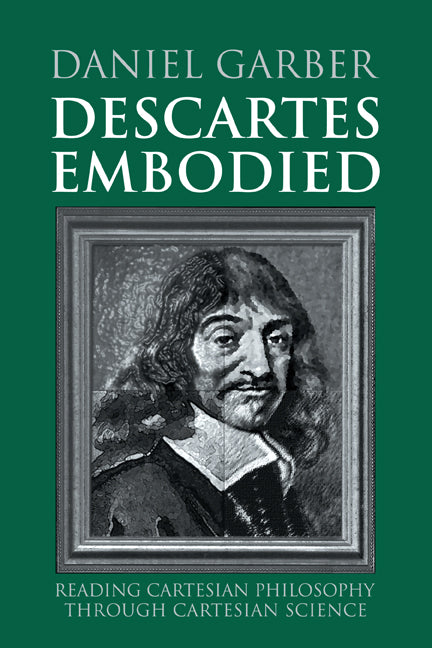
Descartes Embodied
Reading Cartesian Philosophy through Cartesian Science
This volume collects some of the seminal essays on Descartes by Daniel Garber, a pre-eminent scholar of early-modern philosophy.
Daniel Garber (Author)
9780521789738, Cambridge University Press
Paperback / softback, published 20 November 2000
352 pages, 3 b/w illus. 2 tables
22.6 x 15 x 2.5 cm, 0.52 kg
'One of the merits of these essays is that they engage with the full scope of Descartes's texts, and are sensitive to variations between Latin and French versions of the originals.' British Journal for the History of Philosophy
This volume collects some of the seminal essays on Descartes by Daniel Garber, one of the pre-eminent scholars of early-modern philosophy. A central theme unifying the volume is the interconnection between Descartes' philosophical and scientific interests, and the extent to which these two sides of the Cartesian program illuminate each other, a question rarely treated in the existing literature. Amongst the specific topics discussed in the essays are Descartes' celebrated method, his demand for certainty in the sciences, his account of the relation of mind and body, and his conception of God's activity on the physical world. This collection will be a mandatory purchase for any serious student of or professional working in seventeenth-century philosophy, history of science, or history of ideas.
Introduction
Part I. Historiographical Preliminaries: 1. Does history have a future? Some reflections on Bennett and doing philosophy historically
Part II. Method, Order and Certainty: 2. Descartes and method in 1637
3. A point of order: analysis, synthesis, and Descartes's Principles
4. J. B. Morin and the Second Objections
5. Descartes and experiment in the Discourse and Essays
6. Descartes on knowledge and certainty
Part III. Mind, Body, and the Laws of Nature: 7. Mind, body, and the laws of nature in Descartes and Leibniz
8. Understanding interaction: what Descartes should have told Elizabeth
9. How God causes motion: Descartes, divine sustenance, and occasionalism
10. Descartes and occasionalism
11. Semel in Vita: the scientific background to Descartes meditations
12. Forms and qualities in the Sixth Replies
Part IV. Larger Visions: 13. Descartes, or the cultivation of the intellect
14. Experiment, community, and the constitution of nature in the seventeenth century.
Subject Areas: History of Western philosophy [HPC]