Freshly Printed - allow 3 days lead
Couldn't load pickup availability
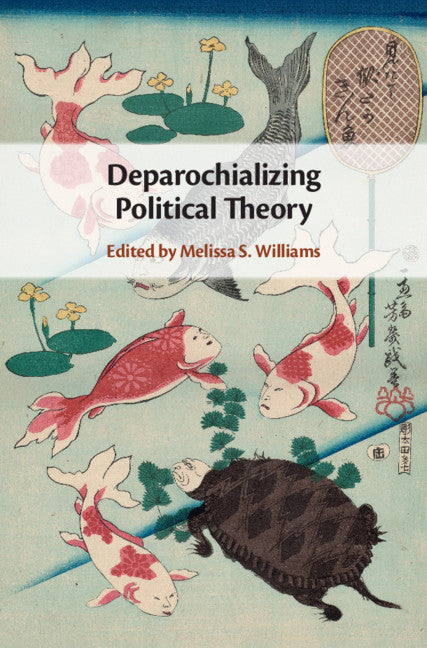
Deparochializing Political Theory
Leading political theorists demonstrate the transformative potential of de-centering Western traditions in the field of political theory.
Melissa S. Williams (Edited by)
9781108480505, Cambridge University Press
Hardback, published 2 April 2020
324 pages, 2 tables
23.5 x 15.7 x 2.3 cm, 0.57 kg
'This outstanding volume ranges from exciting new departures to thoughtful reflections on lifetimes of scholarship. Williams convincingly illustrates that there is no one answer or route to practicing comparative political theory; what we need right now is not a single road map, but a range of options and vigorous debate.' Stephen C. Angle, Wesleyan University, Connecticut
In a world no longer centered on the West, what should political theory become? Although Western intellectual traditions continue to dominate academic journals and course syllabi in political theory, up-and-coming contributions of 'comparative political theory' are rapidly transforming the field. Deparochializing Political Theory creates a space for conversation amongst leading scholars who differ widely in their approaches to political theory. These scholars converge on the belief that we bear a collective responsibility to engage and support the transformation of political theory. In these exchanges, 'deparochializing' political theory emerges as an intellectual, educational and political practice that cuts across methodological approaches. Because it is also an intergenerational project, this book presses us to re-imagine our teaching and curriculum design. Bearing the marks of its beginnings in East Asia, Deparochializing Political Theory seeks to de-center Western thought and explore the evolving tasks of political theory in an age of global modernity.
1. Introduction. The practice of deparochializing political theory Melissa S. Williams
2. Deparochializing political theory and beyond: a dialogue approach to comparative political thought James Tully
3. Recentering political theory, revisited: on mobile locality, general applicability, and the future of comparative political theory Leigh K. Jenco
4. A decentralized republic of virtue: true way learning in the Southern Song period and beyond Youngmin Kim
5. Deparochializing political theory from the Far Eastern Province Ken Tsutsumibayashi
6. Is popular sovereignty a useful myth? Joseph Chan and Franz Mang
7. Authoritarian and democratic pathways to meritocracy in China Baogang He and Mark E. Warren
8. Deparochializing democratic theory Melissa S. Williams
9. Teaching comparative political thought: joys, pitfalls, strategies, significance Stephen Salkever
10. Teaching philosophy and political thought in Southeast Asia Terry Nardin
11. Why globalize the curriculum? Duncan Ivison.
Subject Areas: Comparative politics [JPB], Political science & theory [JPA], Social & political philosophy [HPS]