Freshly Printed - allow 8 days lead
Couldn't load pickup availability
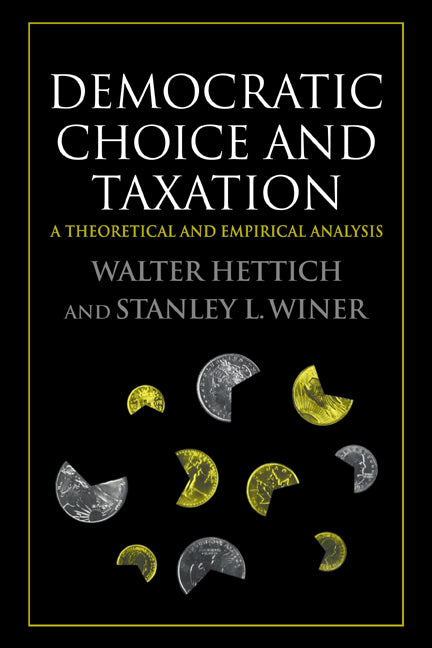
Democratic Choice and Taxation
A Theoretical and Empirical Analysis
This book uses general equilibrium model, plus round-up of recent literature to show how tax policies and systems arise from democratic choices.
Walter Hettich (Author), Stanley L. Winer (Author)
9780521622912, Cambridge University Press
Hardback, published 13 February 1999
344 pages, 30 b/w illus. 19 tables
23.8 x 16.1 x 2.5 cm, 0.66 kg
'… the book is an extremely useful addition to the evolving literature.' Economica
This work examines tax policies and tax systems as they arise from democratic choices, set against the background of a market economy. Professors Hettich and Winer find that democratic institutions yield complex tax systems with features that follow a varied but predictable pattern. In developing their analysis, the authors use formal modelling of voting behavior, emphasizing recent advances in the theory of probabilistic voting. This book differs from the available tax literature by relating fiscal choices directly to voting and by examining tax systems in democratic countries from a variety of perspectives. While the authors primarily focus on explaining observed features of tax systems, they also devote considerable space to the discussion of the welfare and efficiency effects of taxation in the presence of collective choice, and to a review of other models and of the related literature. In addition, they use computational general equilibrium analysis and statistical research on national and state governments in the US and Canada to link theory to empirical data.
1. Introduction
Part I. Theoretical Framework: 2. Models of political economy and the study of taxation
3. Foundations of democratic tax systems
4. Tax structure in equilibrium: a more formal analysis
Part II. Collective Choice and the Normative Analysis of Taxation: 5. An assessment of normative tax theory
6. Welfare politics and taxation
Part III. Applied General Equilibrium Analysis: 7. Tax policy in a computable model of economic and political equilibrium
Part IV. Statistical Analysis of Tax Structure: 8. Introduction to statistical research
9. Income taxation and special provisions: evidence from the US states
10. Debt and tariffs: the evolution of the Canadian revenue system
Part V. Political Institutions and Taxation: 11. Tax systems in congressional and parliamentary countries
12. Conclusion
Endnotes
References
Index.
Subject Areas: Political economy [KCP]