Freshly Printed - allow 10 days lead
Couldn't load pickup availability
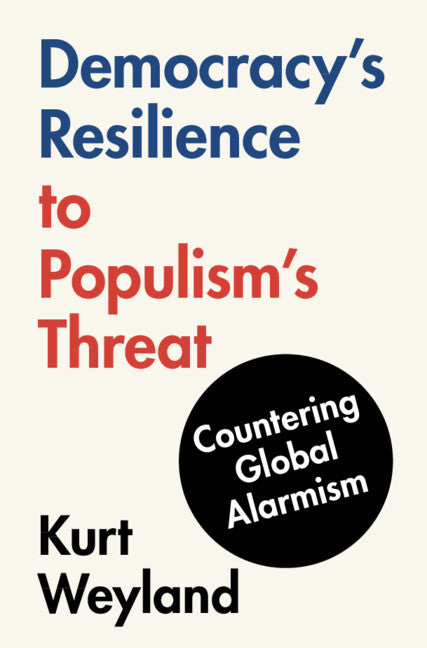
Democracy's Resilience to Populism's Threat
Countering Global Alarmism
Analyzes contemporary Latin America, Europe, and the United States to show the many ways democracies withstand populism's threat.
Kurt Weyland (Author)
9781009432467, Cambridge University Press
Hardback, published 25 January 2024
322 pages
23.6 x 15.9 x 2.2 cm, 0.59 kg
'Weyland's book is a significant contribution to our understanding of the conditions that lead to the end of democracy under populism.' Julio F. Carrión, Political Science Quarterly
The recent global wave of populist governments, which culminated in Donald Trump's victory in 2016, has convinced many observers that populism is a grave threat to democracy. In his new book, Kurt Weyland critiques recent scholarship for focusing too closely on cases where populist leaders have crushed democracy, and instead turns to the many cases where would populist-authoritarians have failed to overthrow democracy. Through a systematic comparative analysis of thirty populist chief executives in Latin America and Europe over the last four decades, Weyland reveals that populist leaders can only destroy democracy under special, restrictive conditions. Left-wing populists suffocate democracy only when benefitting from huge revenue windfalls, whereas right-wing populists must perform the heroic feat of resolving acute, severe crises. Because many populist chief executives do not face these propitious conditions, Weyland proves that despite populism's threat, democracy remains resilient.
1. The Populist Threat to Democracy
2. How Institutional Constraints and Conjunctural Opportunities Condition Populism's Threat to Democracy
3. Neoliberal and Rightwing Populism in Latin America
4. 'Bolivarian' and Leftwing Populism in Latin America
5. Rightwing and Traditionalist Populism in Europe
6. Rightwing Populism in the US: Donald Trump in Comparative Perspective
7. Conclusion: Theoretical and Comparative Implications.
Subject Areas: Comparative politics [JPB]