Freshly Printed - allow 10 days lead
Couldn't load pickup availability
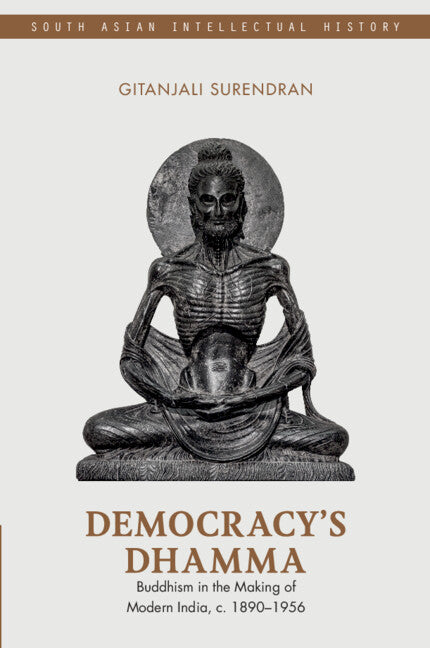
Democracy's Dhamma
Buddhism in the Making of Modern India, c. 1890–1956
Democracy's Dhamma is a genealogy of the engagement with Buddhism in modern India.
Gitanjali Surendran (Author)
9781009424950, Cambridge University Press
Hardback, published 2 January 2025
368 pages
23.5 x 15.9 x 2.9 cm, 0.7 kg
'The rediscovery of India's Buddhist heritage-a global enterprise if ever there was one-is really a post-mid-19th-century development in which many remarkable personalities from South and Southeast Asia played a pivotal role. Surendran tells this fascinating story of the rediscovery of India's Buddhist heritage especially-one that was to have a deep and enduring impact on India's nationalist movement as is evident in, for instance, the choice of the national flag and the national symbol …' Jairam Ramesh, member of parliament, former minister and author
In 1956, B. R. Ambedkar publicly converted to Buddhism raising questions about his turn from constitutionalism to religion. The answer lies in Buddhism itself. In the late colonial era, the struggle to produce an appropriate Buddhism for a nation-in-the-making reveals a secret history foundational to modern India. Thinkers, activists, reformers, pilgrims, and monks from around South, Southeast and East Asia discussed universalism, nationalism, modernity, democracy, and caste radicalism and advocated an Indian return to Buddhism and the Buddha. This book traces this genealogy through the Buddhist itineraries and political projects of figures like Anagarika Dharmapala, Swami Vivekananda, Rabindranath Tagore, Jawaharlal Nehru, Vinayak D. Savarkar, Rahul Sankrityayan and Ambedkar, to reveal how Buddhism emerged as democracy's dhamma, the religion of democracy.
List of Figures
Acknowledgements
List of Abbreviations
Introduction: Buddhism in the Making of Modern India
1. Anagarika Dharmapala in India
2. Dharmapala and Vivekananda in an Age of Universalism
3. Buddhism and the Bhadralok
4. The Buddhist Bay: Buddhist Mobility across the Bay of Bengal
5. Buddhist Relics, the Mahabodhi Temple and the Discourse of a Shared Buddhism
6. Buddhism as a Civil Religion and Hindutva
7. Buddhism, Anti-Caste Radicalism and Socialism
8. Ambedkar, Dhamma and Democracy
Conclusion: The Destinies of Buddhism
Bibliography
Index.
Subject Areas: Asian history [HBJF]