Freshly Printed - allow 10 days lead
Couldn't load pickup availability
Democracy, Revolution, and Monarchism in Early American Literature
This is an ambitious study of an important theme in early American culture and society.
Paul Downes (Author)
9780521100298, Cambridge University Press
Paperback / softback, published 18 January 2009
256 pages
22.9 x 15.2 x 1.5 cm, 0.38 kg
"Downe's Democracy deconstructs the traditional opposition between monarchy and democracy, thus advancing a compelling argument of how the extension of democratic rights owes much to its inheritance from monarchy. Unapologetically theoretical, Downes creates an engaging dialogue with the work of philosophers and political theorists like Derrida, Balibar, Adrendt, Laclau and Mouffe. The result is a work that provides a fresh methodological approach to the field of early American literature." English Studies in Canada,/i Pablo Ramirez, University of Guelph
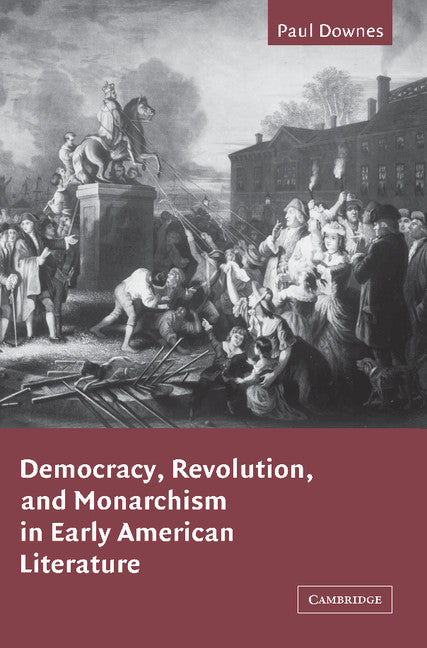
Paul Downes combines literary criticism and political history in order to explore responses to the rejection of monarchism in the American revolutionary era. Downes' analysis considers the Declaration of Independence, Franklin's autobiography, Crèvecoeur's Letters from an American Farmer and the works of America's first significant literary figures including Charles Brockden Brown, Washington Irving and James Fenimore Cooper. He claims that the post-revolutionary American state and the new democratic citizen inherited some of the complex features of absolute monarchy, even as they were strenuously trying to assert their difference from it. In chapters that consider the revolution's mock execution of George III, the Elizabethan notion of the 'king's two bodies' and the political significance of the secret ballot, Downes points to the traces of monarchical political structures within the practices and discourses of early American democracy. This is an ambitious study of an important theme in early American culture and society.
Preface
Acknowledgements
Introduction: the spell of democracy
1. Monarchophobia: reading the mock executions of 1776
2. Crèvecoeur's revolutionary loyalism
3. Citizen subjects: the memoirs of Stephen Burroughs and Benjamin Franklin
4. An epistemology of the ballot box: Brockden Brown's secrets
5. Luxury, effeminacy, corruption: Irving and the gender of democracy
Afterword: the revolution's last word
Notes, Bibliography
Index.
Subject Areas: History of the Americas [HBJK], Literary studies: general [DSB]