Freshly Printed - allow 10 days lead
Couldn't load pickup availability
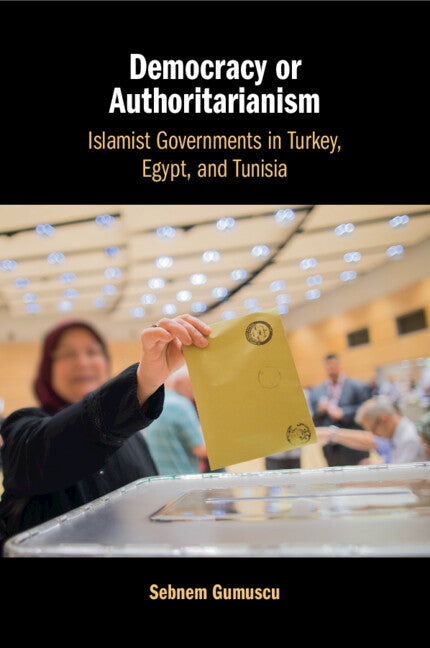
Democracy or Authoritarianism
Islamist Governments in Turkey, Egypt, and Tunisia
Traces the evolution of three Islamist governments to explain why some commit to democracy while others devolve into authoritarianism.
Sebnem Gumuscu (Author)
9781009178242, Cambridge University Press
Paperback / softback, published 6 February 2025
312 pages
22.9 x 15.2 x 1.7 cm, 0.454 kg
'[This] book convinces with a very rich data basis, retracing historical developments of the three parties/movements and reminds us that it is important to assess how and what type of democracy is perceived and interpreted by (different levels within) key actors.' Jan-Erik Refle, Zeitschrift für Vergleichende Politikwissenschaft
The first Islamist parties to come to power through democratic means in the Muslim world were those in Turkey, Tunisia, and Egypt. The Justice and Development Party (AKP) won the 2002 election in Turkey, and Ennahda (Renaissance Party) in Tunisia and the Muslim Brotherhood in Egypt were both elected in the wake of the Arab uprisings of 2010/11. Yet only Ennahda could be said to have fulfilled its democratic promise, with both the Turkish and Egyptian governments reverting to authoritarianism. Drawing upon extensive fieldwork in three countries, Sebnem Gumuscu explains why some Islamist governments adhered to democratic principles and others took an authoritarian turn following electoral success. Using accessible language, Gumuscu clearly introduces key theories and considers how intra-party affairs impacted each party's commitment to democracy. Through a comparative lens, Gumuscu identifies broader trends in Islamist governments and explains the complex web of internal dynamics that led political parties either to advance or subvert democracy.
Introduction
1. Modernization, inclusion, and power: explaining Islamist parties' democratic commitments
2. A theory of intra-party politics: resources and coalitions
3. The AKP's pivot from liberal democracy to electoral Islamism
4. Electoral Islamism and killing the dream of a democratic Muslim brotherhood
5. Ennahda's path towards liberal Islamism
Conclusion.
Subject Areas: Religious & theocratic ideologies [JPFR], Comparative politics [JPB], Middle Eastern history [HBJF1]