Freshly Printed - allow 10 days lead
Couldn't load pickup availability
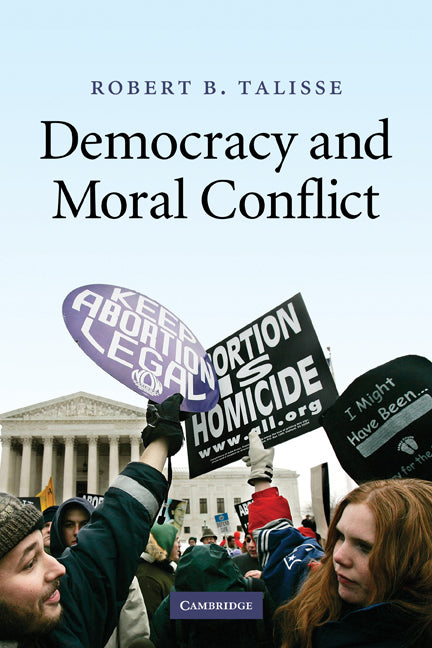
Democracy and Moral Conflict
If confronted with a democratic result they regard as intolerable, should citizens revolt or pursue democratic means of social change?
Robert B. Talisse (Author)
9780521513548, Cambridge University Press
Hardback, published 10 September 2009
216 pages
22.9 x 15.2 x 1.6 cm, 0.49 kg
'Robert B. Talisse's book, Democracy and Moral Conflict, remains one of the most important attempts to solve the problem of democratic legitimacy in the context of the pluralism that characterizes modern society.' Logos & Episteme
Why democracy? Most often this question is met with an appeal to some decidedly moral value, such as equality, liberty, dignity or even peace. But in contemporary democratic societies, there is deep disagreement and conflict about the precise nature and relative worth of these values. And when democracy votes, some of those who lose will see the prevailing outcome as not merely disappointing, but morally intolerable. How should citizens react when confronted with a democratic result that they regard as intolerable? Should they revolt, or instead pursue democratic means of social change? In this book, Robert Talisse argues that each of us has reasons to uphold democracy - even when it makes serious moral errors - and that these reasons are rooted in our most fundamental epistemic commitments. His original and compelling study will be of interest to a wide range of readers in political philosophy and political theory.
Introduction
1. The problem of deep politics
2. Against the politics of omission
3. Folk epistemology
4. Justifying democracy
5. Epistemic perfectionism
Works cited.
Subject Areas: Political structures: democracy [JPHV], Political science & theory [JPA], Social & political philosophy [HPS]