Freshly Printed - allow 10 days lead
Couldn't load pickup availability
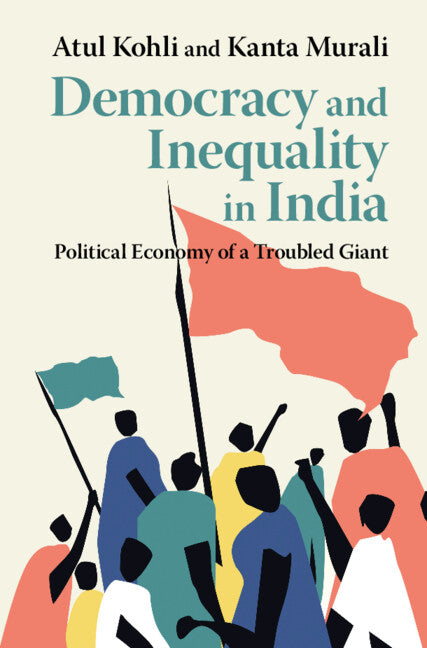
Democracy and Inequality in India
Political Economy of a Troubled Giant
This in-depth political and economic analysis demonstrates that India's growing economic inequality is contributing to democratic decline.
Atul Kohli (Author), Kanta Murali (Author)
9781108471831, Cambridge University Press
Hardback, published 30 October 2025
360 pages
22.9 x 15.2 x 2.1 cm, 0.696 kg
'Kohli and Murali, both political scientists, compellingly assert that India's elite-driven economic growth has eroded the foundations of the country's democracy … they provide a sobering account of what concentrated economic power and an entrenched social hierarchy do to a democracy.' Pratap Bhanu Mehta, Foreign Affairs
Contemporary India provides a giant and complex panorama that deserves to be understood. Through in-depth analysis of democracy, economic growth and distribution, caste, labour, gender, and foreign policy, Atul Kohli and Kanta Murali provide a framework for understanding recent political and economic developments. They make three key arguments. Firstly, that India's well-established democracy is currently under considerable strain. Secondly, that the roots of this decline can be attributed to the growing inequalities accompanying growth since the 1990s. Growing inequalities led to the decline of the Congress party and the rise of the BJP under Narendra Modi. In turn, the BJP and its Hindu-nationalist affiliates have used state power to undermine democracy and to target Indian Muslims. Finally, they highlight how various social groups reacted to macro-level changes, although the results of their activism have not always been substantial. Essential reading for anyone wishing to understand democracy in India today.
Introduction
I. Politics at the Apex: 1. Democracy and governance
2. Politics of growth and distribution
II. Politics from Below: 3. Caste, politics, and development
4. Labor, gender, and civil society mobilization
III. Regional Diversities: 5. Overview of regional diversity
6. Illustrating regional differences: Gujarat, Uttar Pradesh, Tamil Nadu, and Punjab
IV. India and the World: 7. India and the world
Conclusion.
Subject Areas: Constitution: government & the state [JPHC]