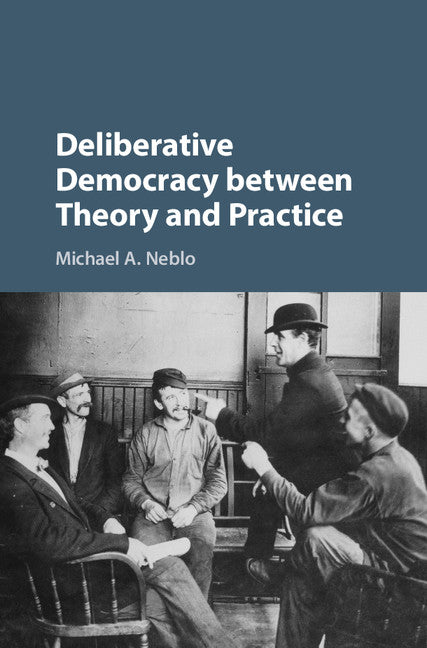
Freshly Printed - allow 10 days lead
Couldn't load pickup availability
Deliberative Democracy between Theory and Practice
This book offers a model to bridge the differences between political theorists and social scientists, focusing on deliberative practices.
Michael A. Neblo (Author)
9781107027671, Cambridge University Press
Hardback, published 19 November 2015
232 pages, 3 b/w illus.
23.1 x 15.7 x 2.3 cm, 0.48 kg
'For citizens, students, and scholars who care about deliberation and democracy in theory and practice, Michael A. Neblo's work is essential reading … Deliberative Democracy between Theory and Practice points the way forward to more productive interaction between deliberative theorists and empirical social scientists, helping both sides to avoid talking past each other and opening up promising avenues for evaluating the deliberative system. Neblo's work is both clear-eyed and deeply empathetic: he confronts squarely the limitations and vexing challenges of citizenship in modern mass democracy, while still retaining a capacious sense of care and respect for the ordinary women and men whose views and conversations are at the heart of the deliberative system. [The book] thus holds up a vision of deliberative democratic citizenship that is at once empirically grounded and theoretically rich.' Christopher Karpowitz, Co-Director, Center for the Study of Elections and Democracy, Brigham Young University, Utah, and author of Deliberation, Democracy, and Civic Forums
Deliberative democrats seek to link political choices more closely to the deliberations of common citizens, rather than consigning them to speak only in the desiccated language of checks on a ballot. Sober thinkers from Plato to today, however, have argued that if we want to make good decisions we cannot entrust them to the deliberations of common citizens. Critics argue that deliberative democracy is wildly unworkable in practice. Deliberative Democracy between Theory and Practice cuts across this debate by clarifying the structure of a deliberative democratic system, and goes on to re-evaluate the main empirical challenges to deliberative democracy in light of this new frame. It simultaneously reclaims the wider theory of deliberative democracy and meets the empirical critics squarely on terms that advance, rather than evade, the debate. Doing so has important implications for institutional design, the normative theory of democracy, and priorities for future research and practice.
1. Introduction: common voices
2. Form follows function
3. Framing the public
4. How deliberation counts
5. Who wants to deliberate?
6. A few days of democracy camp
7. Conclusion: a preface to deliberative democratic theory.
Subject Areas: Political science & theory [JPA], Social, group or collective psychology [JMH], Social theory [JHBA], Sociology [JHB], History of ideas [JFCX], Social & political philosophy [HPS]