Freshly Printed - allow 10 days lead
Couldn't load pickup availability
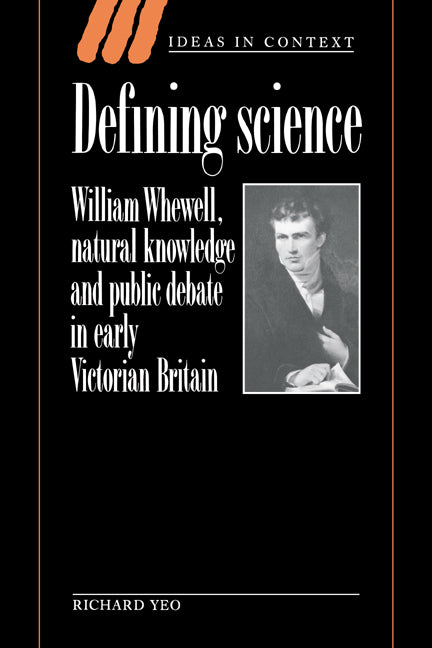
Defining Science
William Whewell, Natural Knowledge and Public Debate in Early Victorian Britain
A 1993 assessment of the role of the historian and philosopher of science, William Whewell, in early Victorian debates about the nature of science.
Richard Yeo (Author)
9780521541169, Cambridge University Press
Paperback / softback, published 18 September 2003
300 pages
22.8 x 15.2 x 1.9 cm, 0.463 kg
'… at once a seminal vocational biography of the most prominent Victorian metascientist, and a penetrating study of the complex debate about the nature of science in nineteenth century Britain. It is a book no student of Victorian intellectual history can afford to ignore.' Isis
This 1993 book deals with debates about science - its history, philosophy and moral value - in the first half of the nineteenth century, a period in which the 'modern' features of science developed. Defining Science also examines the different forms or genres in which science was discussed in the public sphere - most crucially in the Victorian review journals, but also in biographical, historical and educational works. William Whewell wrote major works on the history and philosophy of science before these became technical subjects. Consequently he had to define his own role as a metascientific critic (in a manner akin to cultural critics like Coleridge and Carlyle) as well as seeking to define science for both expert and lay audiences.
Preface
1. Introduction
2. Science and the public sphere
3. Metascience as a vocation
4. Reviewing science
5. Moral scientists
6. Using history
7. Moral science
8. Science, education and society
9. The unity of science.
Subject Areas: History of ideas [JFCX]