Freshly Printed - allow 10 days lead
Couldn't load pickup availability
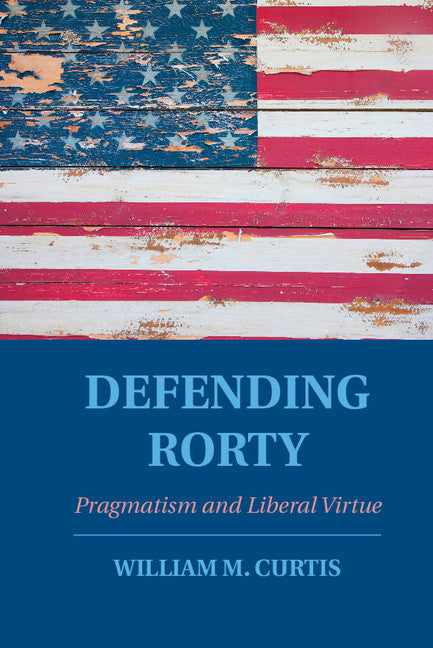
Defending Rorty
Pragmatism and Liberal Virtue
Mixing American pragmatism and romanticism, Richard Rorty defends liberal democracy as an antiauthoritarian political regime based on liberal civic virtues.
William M. Curtis (Author)
9781107109858, Cambridge University Press
Hardback, published 14 August 2015
300 pages
23.5 x 16 x 2.5 cm, 0.61 kg
'Curtis' book opens up an important space for thinking about the possibilities for and of virtue liberalism, and also for thinking about Rorty qua political thinker.' Susan Dieleman, Contemporary Pragmatism
Liberal democracy needs a clear-eyed, robust defense to deal with the increasingly complex challenges it faces in the twenty-first century. Unfortunately much of contemporary liberal theory has rejected this endeavor for fear of appearing culturally hegemonic. Instead, liberal theorists have sought to gut liberalism of its ethical substance in order to render it more tolerant of non-liberal ways of life. This theoretical effort is misguided, however, because successful liberal democracy is an ethically demanding political regime that requires its citizenry to display certain virtues and habits of mind. Against the grain of contemporary theory, philosopher Richard Rorty blends American pragmatism and romanticism to produce a comprehensive vision of liberal modernity that features a virtue-based conception of liberal democracy. In doing so, Rorty defends his pragmatic liberalism against a host of notable interlocutors, including Charles Taylor, Nancy Fraser, Hilary Putnam, Richard J. Bernstein, and Jean Bethke Elshtain.
Introduction: defending California: Richard Rorty's virtue liberalism
1. Rorty's pragmatism: the critique of philosophy
2. Rorty's pragmatic virtue liberalism
3. Critics: from left to right
4. Rorty vs Taylor: ontology, pluralism, and authoritarianism
5. Rorty, religion, and pragmatic liberalism
6. Rorty's liberal utopia and Huxley's pragmatist Island
7. Conclusion.
Subject Areas: Political structures: democracy [JPHV], Political structure & processes [JPH], Liberalism & centre democratic ideologies [JPFK], Political science & theory [JPA], Social & political philosophy [HPS]