Freshly Printed - allow 10 days lead
Couldn't load pickup availability
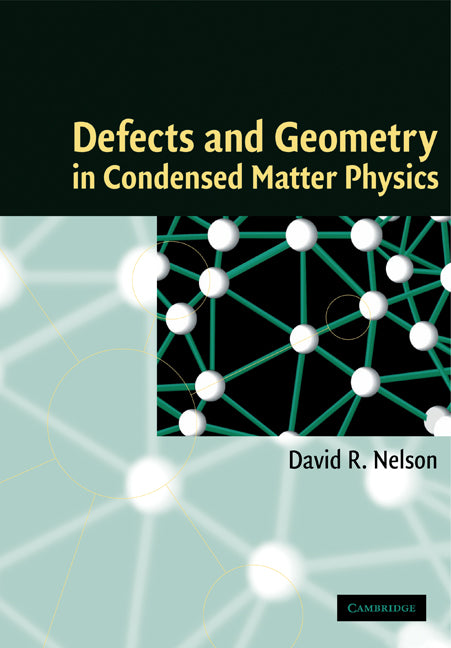
Defects and Geometry in Condensed Matter Physics
A pedagogic graduate level introduction to the field of defects and geometry, first published in 2002.
David R. Nelson (Author)
9780521004008, Cambridge University Press
Paperback / softback, published 18 March 2002
392 pages, 140 b/w illus. 2 tables
24.7 x 17.6 x 2 cm, 0.62 kg
'For 25 years, David Nelson has made major contributions to the study of how condensed matter systems as solids, liquid crystals, superfluids, and polymer solutions and melts. His dominance in the field has been reinforced by his excellent surveys in the proceedings of summer schools, workshops, and conferences from 1983 to 1996. The book provides an admirable overview of Nelson's achievements and of their relation to other work.' Physics Today
Thermally excited defects such as vortices, disclinations, dislocations, vacancies and interstitials play a key role in the physics of crystals, superfluids, superconductors, liquid crystals and polymer arrays. Geometrical aspects of statistical mechanics become particularly important when thermal fluctuations entangle or crumple extended line-like or surface-like objects in three dimensions. In the case of entangled vortices above the first-order flux lattice melting transition in high temperature superconductors, the lines themselves are defects. A variety of low temperature theories combined with renormalization group ideas are used to describe the delicate interplay between defects, statistical mechanics and geometry characteristic of these problems in condensed matter physics. In this 2002 book, David Nelson provides a coherent and pedagogic graduate level introduction to the field of defects and geometry.
1. Fluctuations, renormalization and universality
2. Defect mediated phase transitions
3. Order, frustration
4. The structure and statistical mechanics of glass
5. The statistical mechanics of crumpled membranes
6. Defects in superfluids, superconductors and membranes
7. Vortex line fluctuations in superconductors from elementary quantum mechanics
8. Correlations and transport in vortex liquids
9. The statistical mechanics of directed polymers.
Subject Areas: Condensed matter physics [liquid state & solid state physics PHFC]