Freshly Printed - allow 8 days lead
Couldn't load pickup availability
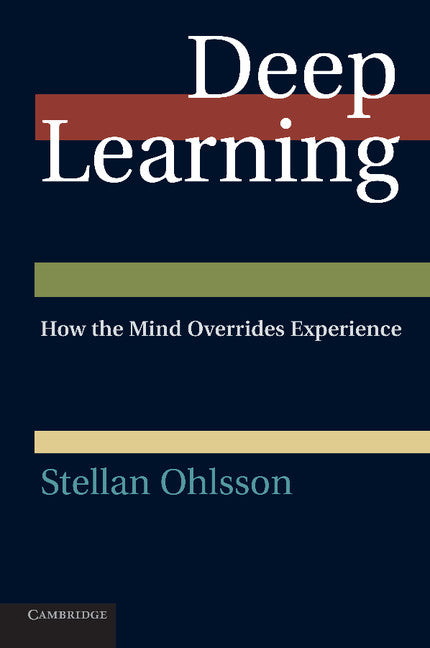
Deep Learning
How the Mind Overrides Experience
In this volume, cognitive scientist Stellan Ohlsson presents a unified theory of the mind's response to complex, turbulent environments.
Stellan Ohlsson (Author)
9781107661363, Cambridge University Press
Paperback / softback, published 12 November 2013
540 pages, 44 b/w illus. 15 tables
22.9 x 15.2 x 2.8 cm, 0.71 kg
"...This landmark book present theories of creativity, adaptation and conversion of belief culminating in elements of a unified theory, showing that we must override experience to understand how the mind works.... The book addresses continuous learning at multiple levels, from the micro-level of individual cognitive processing to the societal level of continuous learning and adaptation to change.... the book is seminal reading for doctoral students and researchers in cognitive psychology and for advance readers in disciplines such as education, decision science, artificial intelligence, and group dynamics....Deep Learning is a significant academic work explaining discontinuous processes that puzzle and challenge all of us.... The book is an erudite yet elegant and deep exposition of a new generation of cognitive learning theory and research.... This is a work of brilliant scholarship...."
–Manuel London, State University of New York at Stony Brook, American Journal of Psychology
Although the ability to retain, process, and project prior experience onto future situations is indispensable, the human mind also possesses the ability to override experience and adapt to changing circumstances. Cognitive scientist Stellan Ohlsson analyzes three types of deep, non-monotonic cognitive change: creative insight, adaptation of cognitive skills by learning from errors, and conversion from one belief to another, incompatible belief. For each topic, Ohlsson summarizes past research, re-formulates the relevant research questions, and proposes information-processing mechanisms that answer those questions. The three theories are based on the principles of redistribution of activation, specialization of practical knowledge, and re-subsumption of declarative information. Ohlsson develops the implications of those mechanisms by scaling their effects with respect to time, complexity, and social interaction. The book ends with a unified theory of non-monotonic cognitive change that captures the abstract properties that the three types of change share.
Part I. Introduction: 1. The need to override experience
2. The nature of the enterprise
Part II. Creativity: 3. The production of novelty
4. Creative insight: the redistribution theory
5. Creative insight writ large
Part III. Adaptation: 6. The growth of competence
7. Error correction: the specialization theory
8. Error correction in context
Part IV. Conversion: 9. The formation of belief
10. Belief revision: the resubsumption theory
Part V. Conclusion: 11. Elements of a unified theory
12. The recursion curse.
Subject Areas: Cognition & cognitive psychology [JMR]