In Stock - dispatch within 48 hours
Couldn't load pickup availability
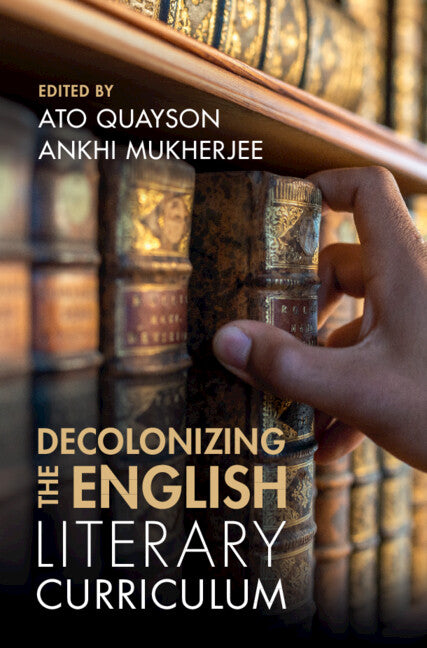
Decolonizing the English Literary Curriculum
Leading scholars illustrate the necessity and advantages of reforming the English Literary Curriculum from decolonial perspectives.
Ato Quayson (Edited by), Ankhi Mukherjee (Edited by)
9781009299954, Cambridge University Press
Hardback, published 9 November 2023
542 pages
23.5 x 16 x 3.2 cm, 0.87 kg
'Recommended.' L. Zhang, CHOICE
George Floyd's death on May 25th 2020 marked a watershed in reactions to anti-Black racism in the United States and elsewhere. Intense demonstrations around the world followed. Within literary studies, the demonstrations accelerated the scrutiny of the literary curriculum, the need to diversify the curriculum, and the need to incorporate more Black writers. Decolonizing the English Literary Curriculum is a major collection that aims to address these issues from a global perspective. An international team of leading scholars illustrate the necessity and advantages of reform from specific decolonial perspectives, with evidence-based arguments from classroom contexts, as well as establishing new critical agendas. The significance of Decolonizing the English Literary Curriculum lies in the complete overhaul it proposes for the study of English literature. It reconnects English studies, the humanities, and the modern, international university to issues of racial and social justice. This book is also available as Open Access on Cambridge Core.
Introduction Ankhi Mukherjee and Ato Quayson
Part I. Identities: 1. Decolonizing the university Paul Giles
2. Decolonizing the English department in Ireland Joe Cleary
3. First Peoples, Indigeneity and teaching indigenous writing in Canada Margery Fee and Deanna Reder
4. Decolonising literary pedagogies in Australia and Aotearoa New Zealand Elizabeth McMahon
5. Gender, sexualities and decolonial methodologies Brinda Bose
6. Black British literature decolonizing the curriculum Ankhi Mukherjee
Part II. Methodologies: 7. Theories of anthologizing and decolonization Aarthi Vadde
8. Confabulation as decolonial pedagogy in Singaporean literature Joanne Leow
9. Marxism, postcolonialism and decolonization of literary studies Stefan Helgesson
10. Against ethnography: on teaching minority literature Jeanne-Marie Jackson
11. Orality, experiential learning and a decolonizing African literature at the university of Ghana Kwabena Opoku-Agyemang
12. Vernacular English in the classroom, a new geopolitics of the ground beneath our feet Akshya Saxena
13. Reading for justice: on the pleasures and pitfalls of a decolonializing pedagogy Ato Quayson
Part III. Interdisciplinarity and literary studies: 14. Literature, human rights law and the return of decolonization Joseph R. Slaughter
15. Decolonizing literary interpretation through disability Christopher Krentz
16. Decolonizing the Bible as literature Ronald Charles
17. Decolonizing literature: a history of medicine perspective Sloan Mahone
Part IV. Canon Revisions: 18. Decolonizing the literary curriculum of medieval studies Geraldine Heng
19. The decolonial imaginary of borderlands Shakespeare Katherine Gillen
20. Decolonizing romantic studies Nigel Leask
21. Victorian studies and decolonization Nasser Mufti
22. Decolonizing world literature Debjani Ganguly
23. Decolonizing the English lyric through diasporic women's poetry Sandeep Parmar
24. Postcolonial poetry and the decolonization of the curriculum Nathan Suhr-Sytsma
25. Decolonizing English literary study in the anglophone Caribbean William Ghosh
26. #RhodesMustFall and the reform of the literature curriculum James Ogude.
Subject Areas: Literary theory [DSA]