Freshly Printed - allow 10 days lead
Couldn't load pickup availability
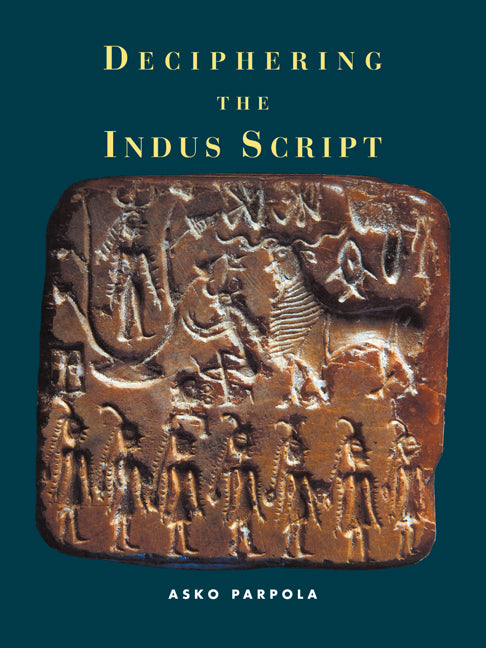
Deciphering the Indus Script
This fascinating study confirms that the Indus script was logo-syllabic and that the Indus language belonged to the Dravidian family.
Asko Parpola (Author)
9780521795661, Cambridge University Press
Paperback / softback, published 1 October 2009
400 pages
28 x 21 x 2.1 cm, 0.89 kg
'… most complete and best-informed treatment of the subject.' Michael D. Coe, Antiquity
Of the writing systems of the ancient world which still await deciphering, the Indus script is the most important. It developed in the Indus or Harappan Civilization, which flourished c. 2500–1900 BC in and around modern Pakistan, collapsing before the earliest historical records of South Asia were composed. Nearly 4,000 samples of the writing survive, mainly on stamp seals and amulets, but no translations. Professor Parpola is the chief editor of the Corpus of Indus Seals and Inscriptions. His ideas about the script, the linguistic affinity of the Harappan language, and the nature of the Indus religion are informed by a remarkable command of Aryan, Dravidian, and Mesopotamian sources, archaeological materials, and linguistic methodology. His fascinating study confirms that the Indus script was logo-syllabic, and that the Indus language belonged to the Dravidian family.
Part I. Introduction: 1. The Indus Civilization and its historical context
Part II. The Indus Script: 2. Early writing systems
3. Deciphering an unknown script
4. Approaches to the Indus script
5. Internal evidence for the type of script used in the Indus Valley
6. Internal evidence on the structure of the Indus language
7. External clues to the Indus script
Part III. The Linguistic Context: 8. In search of the Indus language
9. Dravidian languages and the Harappan culture
Part IV. Interpretations of Indus Pictograms: 10. The 'fish' signs of the Indus script
11. The astronomical and astrological background
12. The trefoil motif: further evidence for astral religion
13. Evidence for Harappan worship of the god Muruku
14. Evidence for Harappan worship of the Goddess
15. Epilogue
Appendix
Bibliographical notes
References
Index.
Subject Areas: Palaeography [history of writing CFL]