Freshly Printed - allow 10 days lead
Couldn't load pickup availability
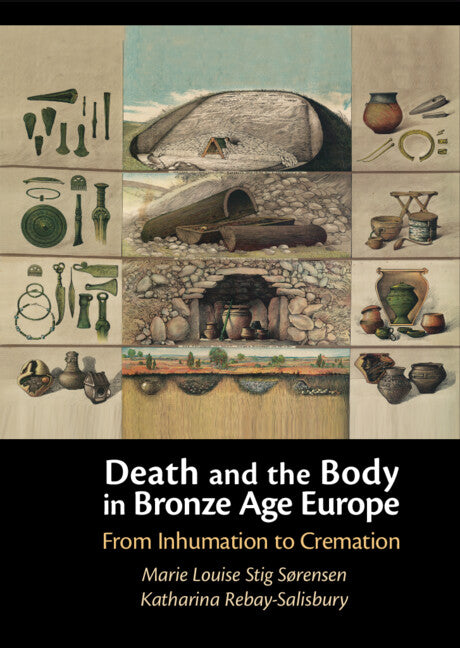
Death and the Body in Bronze Age Europe
From Inhumation to Cremation
The book explains how change in burial practices take place by focussing on how new practices are processed by local communities.
Marie Louise Stig Sørensen (Author), Katharina Rebay-Salisbury (Author)
9781009247399, Cambridge University Press
Hardback, published 5 January 2023
350 pages
26.2 x 18.5 x 1.9 cm, 0.65 kg
'The (renewed) focus on the agency of the (dead) body is refreshing indeed and I think that Stig Sørensen and Rebay-Salisbury have taken an important step towards a new interpretative paradigm. This has been achieved by not only attributing agency to the dead body but, in my view, even more so by attributing agency to local communities by not just seeing them as the passive recipients of new ideas coming from elsewhere. It will be interesting to use their book as a thinking platform in its own right for more detailed and comparative research in the years to come.' Arjan Louwen, Antiquity
This volume offers new insights into the radical shift in attitudes towards death and the dead body that occurred in temperate Bronze Age Europe. Exploring the introduction and eventual dominance of cremation, Marie-Louise Stig Sørenson and Katharina Rebay-Salisbury apply a case-study approach to investigate how this transformation unfolded within local communities located throughout central to northern Europe. They demonstrate the deep link between the living and the dead body, and propose that the introduction of cremation was a significant ontological challenge to traditional ideas about death. In tracing the responses to this challenge, the authors focus on three fields of action: the treatment of the dead body, the construction of a burial place, and ongoing relationships with the dead body after burial. Interrogating cultural change at its most fundamental level, the authors elucidate the fundamental tension between openness towards the 'new' and the conservative pull of the familiar and traditional.
1. Introduction: changing practices and perception of the body
2. A brief history of urns, urnfields and burials in the Urnfield Culture
3. Theoretical framework
4. The Bronze Age: setting the scene
5. The changing Bronze Age body – introduction of case studies
6. The treatment of the body: compatibility and divergence
7. The construction of graves: coherence and variations
8. After the burial: prolonged engagement with the body
9. Conclusions: on the nature of change in burial practices.
Subject Areas: Worship, rites & ceremonies [HRLF], Archaeology [HD], Ancient history: to c 500 CE [HBLA], European history [HBJD]