Freshly Printed - allow 10 days lead
Couldn't load pickup availability
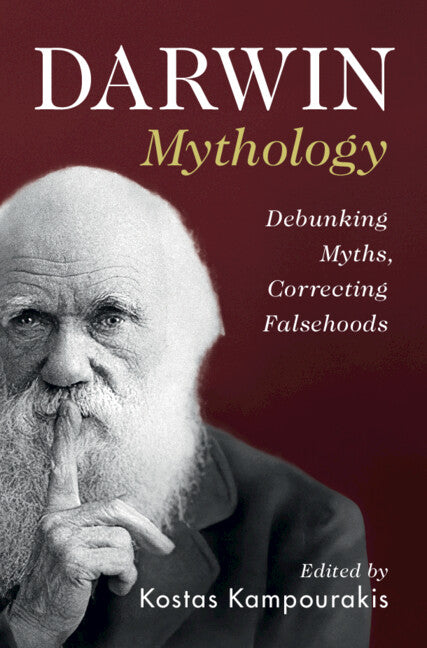
Darwin Mythology
Debunking Myths, Correcting Falsehoods
This accessible collection debunks pervasive myths about Darwin's life and work, deepening our understanding of the history of science.
Kostas Kampourakis (Edited by)
9781009375702, Cambridge University Press
Hardback, published 6 June 2024
328 pages
23.5 x 15.8 x 2.3 cm, 0.62 kg
'This collection of essays by leading historians and philosophers of biology aims to demolish common myths about Charles Darwin … the work should be of interest to scholars …Recommended.' J. S. Schwartz, Choice
Many historical figures have their lives and works shrouded in myth, both in life and long after their deaths. Charles Darwin (1809–82) is no exception to this phenomenon and his hero-worship has become an accepted narrative. This concise, accessible and engaging collection unpacks this narrative to rehumanize Darwin's story and establish what it meant to be a 'genius' in the Victorian context. Leading Darwin scholars have come together to argue that, far from being a lonely genius in an ivory tower, Darwin had fortune, diligence and – crucially – community behind him. The aims of this essential work are twofold. First, to set the historical record straight, debunking the most pervasive myths and correcting falsehoods. Second, to provide a deeper understanding of the nature of science itself, relevant to historians, scientists and the public alike.
Introduction: Myths and Darwin Kostas Kampourakis
1. That myths are simple falsehoods John Heilbron
2. That most European naturalists before Darwin did not think that species change was possible Pietro Corsi
3. That Charles Darwin was not directly influenced by the evolutionary views of his grandfather Erasmus Patricia Fara
4. That Darwin always rejected the argument from design in nature and developed his own theory to replace it Michael Ruse
5. That Darwin converted to evolutionary theory during his historic Galápagos Islands visit Frank Sulloway
6. That Darwin's Galápagos finches inspired his most important evolutionary insights Frank Sulloway
7. That Darwin was a recluse, and a theoretician rather than a practical scientist Alison Pearn
8. That Darwin rejected Lamarck's ideas of use and disuse and of the inheritance of acquired traits Richard W. Burkhardt
9. That Darwin's theory was essentially complete once he came up with the idea of natural selection Alan C. Love
10. That Darwin delayed the publication of his theory for 20 years, being afraid of the reactions it would cause John van Wyhe
11. That Wallace's and Darwin's theories were the same, and that Darwin did not reveal Wallace's 1858 letter and theory until he ensured his own priority Michael Ruse
12. That Huxley was Darwin's bulldog and accepted all aspects of his theory Peter Bowler
13. That Huxley defeated Wilberforce, and ridiculed his obscurantism, in the 1860 Oxford debate John Brooke
14. That Darwin's critics such as Owen were prejudiced and had no scientific arguments Nicolaas Rupke
15. That natural selection can also be accurately described as the survival of the fittest David Depew
16. That Darwin banished teleology from biology James Lennox
17. That Darwin's success depended on undermining 'Aristotelian essentialism' James Lennox
18. That Darwin's theory would have become more widely accepted immediately had he read Mendel's 1866 paper Gregory Radick
19. That Darwin faced a conspiracy of silence in Lamarck's country Liv Grjebine
20. That Hitler endorsed and was influenced by Darwin's theory Robert Richards
21. That sexual selection was Darwin's afterthought to natural selection Kimberly Hamlin
22. That Darwin's hatred of slavery reflected his beliefs in racial equality Erik Peterson
23. That the discovery of Australopithecus in 1925 belatedly confirmed Darwin's 1871 scientific prediction of African human origins Emily Kern
24. That Darwin's theory brought an instant and immediate revolution in the life sciences Shruti Santosh and Anya Plutynski
Conclusion: What inferences about science can we draw from Charles Darwin's life and work Kostas Kampourakis.
Subject Areas: History of engineering & technology [TBX]