Freshly Printed - allow 6 days lead
Couldn't load pickup availability
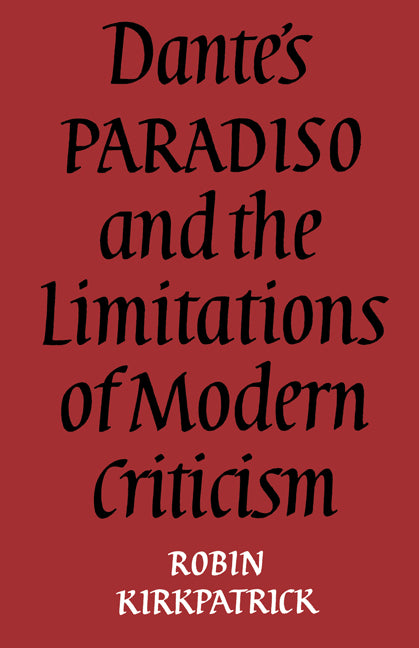
Dante's Paradiso and the Limitations of Modern Criticism
A Study of Style and Poetic Theory
Dr Kirkpatrick analyses Dante's Paradiso through the language, organisation of the poem, and religious and philosophical belief.
Robin Kirkpatrick (Author)
9780521157568, Cambridge University Press
Paperback, published 14 April 2011
240 pages
21.6 x 14 x 1.4 cm, 0.31 kg
In this 1978 book, it is Dr Kirkpatrick's contention that critics have yet to present a satisfactory account of Dante's originality in the Paradiso. We shall best appreciate the Paradiso, he argues, if we recognise that poetry can not only dramatise thought, but also offer a thorough analysis of religious and philosophical belief. Considering Dante's own discussions of poetry and language in the Convivio and De Vulgari Eloquentia, Dr Kirkpatrick claims that, for Dante, direct and careful statement is itself a special responsibility of the poet. This attitude is shown in detail to conflict with a view that critics continue to derive from T. S. Eliot and from theoreticians such as Croce and Terracini, whereby poetic language is allowed only an expressive and imaginative function. Dr Kirkpatrick demonstrates how in practice Dante's adoption of analytical language influences the organisation of his poem and his handling of word and image.
Preface
Acknowledgements
Abbreviations
Note on the translation
Introduction
1. The 'modest voice' and the Paradiso
2. Dante's conception of poetic discipline
3. The stable phrase
4. Independence and the reader of the Paradiso
5. Word and image in the Paradiso
6. The organisation of the canto in the Paradiso
Conclusion
Notes
Select bibliography
Cantos of the Commedia cited in text
Index of names
Index of topics.
Subject Areas: Literary studies: poetry & poets [DSC]