Freshly Printed - allow 7 days lead
Couldn't load pickup availability
Cyber-Physical Systems for Innovating and Transforming Society 5.0
Tanupriya Choudhury (Edited by), Abhijit Kumar (Edited by), Ravi Tomar (Edited by), S. Balamurugan (Edited by), Ankit Vishnoi (Edited by)
9781394197712, Wiley
Hardback, published 15 April 2025
288 pages
22.9 x 15.2 x 1.9 cm, 0.454 kg
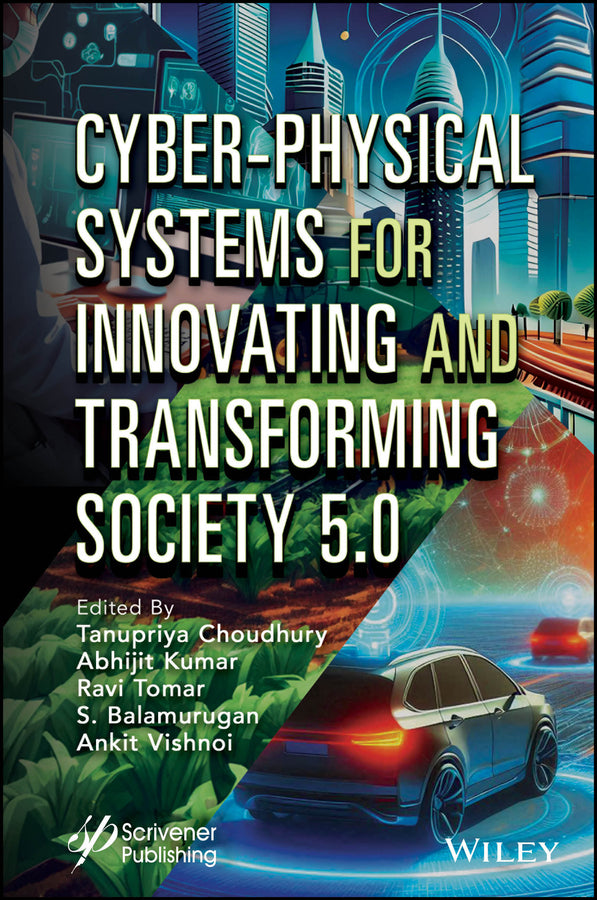
The book presents a suite of innovative tools to reshape society into an interconnected future where technology empowers humans to efficiently resolve pressing socio-economic issues while fostering inclusive growth. This book introduces a spectrum of pioneering advancements across various sectors within Society 5.0, all underpinned by cutting-edge technological innovations. It aims to deliver an exhaustive collection of contemporary concepts, practical applications, and groundbreaking implementations that have the potential to enhance diverse areas of society. Society 5.0 signifies human advancement and is distinguished by its unique synthesis of cyberspace with physical space. This integration harnesses data gathered via environmental sensors, processed by artificial intelligence, to enhance real-world interactions. This volume encompasses an extensive array of scholarly works with detailed insights into fields such as image processing, natural language processing, computer vision, sentiment analysis, and analyses based on voice and gestures. The content presented will be beneficial to multiple disciplines, including the legal system, medical systems, intelligent societal constructs, integrated cyber-physical systems, and innovative agricultural practices. In summary, Cyber-Physical Systems for Innovating and Transforming Society 5.0 presents a suite of innovative tools to reshape society into an interconnected future where technology empowers humans to efficiently resolve pressing socio-economic issues while fostering inclusive growth. Audience The book will be beneficial to researchers, engineers, and students in multiple disciplines, including the legal system, medical systems, intelligent societal constructs, integrated cyber-physical systems, and innovative agricultural practices.
Preface xv Acknowledgement xix 1 Revolutionizing Legal Operations: Benefits and Best Practices of Cyber‐Physical Systems in Society 1.1 Introduction 2 1.1.1 Cyber–Physical System 2 1.1.2 CPS Usage in the Legal Field 3 1.2 Benefits of CPS in the Legal Field 4 1.2.1 Increased Efficiency 4 1.2.2 Enhanced Security 5 1.2.3 Improved Collaboration 6 1.2.4 Predictive Analytics 7 1.3 Applications of CPS in the Legal Field 9 1.3.1 Case Management 9 1.3.2 Contract Management 10 1.3.3 Document Management 11 1.3.4 Legal Research 12 1.3.5 Litigation Support 13 1.4 Challenges of Implementing CPS in the Legal Field 13 1.4.1 Resistance to Change 13 1.4.2 Cost of Implementation 15 1.4.3 Security Concerns 17 1.4.4 Complexity of Integration 18 1.5 Best Practices for Implementing CPS in the Legal Field 19 1.5.1 Understanding the Business Case for CPS 19 1.5.2 Assess the Technology Panorama 20 1.5.3 Develop a Comprehensive Implementation Plan 20 1.5.4 Ensure Statistics’ Privacy and Security 21 1.5.5 Provide Adequate Schooling and Support 22 1.6 Examples of Successful CPS Implementation within the Legal Field 23 1.6.1 Law Firms 23 1.6.2 Corporate Legal Departments 23 1.6.3 Legal Technology Companies 23 1.7 Future of CPS 24 1.7.1 Potential for In-Addition Integration with Different Rising Technology 24 1.7.2 Potential for Extra Performance and Cost Savings 24 1.7.3 Potential for Extended Accuracy and Effectiveness of Criminal Methods 25 1.8 Conclusion 25 1.8.1 Recap of Benefits and Challenges of CPS in the Legal Field 25 1.8.2 Future Outlook for CPS Inside the Legal Subject 26 1.8.3 Way Forward 26 References 27 2 Integrating Predictive Capabilities and Voice Biometric Authentication in Voice Assistants 29 2.1 Introduction 30 2.2 Literature Review 31 2.3 Methodology 34 2.4 Discussion and Result 35 2.4.1 Limitations 39 2.5 Conclusion and Future Scope 39 References 40 3 Leveraging Cloud Computing in Cyber‐Physical Systems for Innovative Society 5.0 43 3.1 Introduction 44 3.2 Scope and Objective 44 3.3 Overview 45 3.4 Layers of Metaverse 46 3.5 Social and Technological Challenges 48 3.6 Evolution 50 3.7 Social and Cultural Implications 52 3.8 Limitation 53 3.9 Conclusion 55 References 56 4 Drone Management System to Detect Fire and Potholes on the Road Towards Smart City 59 4.1 Introduction 59 4.1.1 Management Mechanism 60 4.1.2 Pothole Detection 61 4.1.3 Fire Detection 62 4.2 Proposed Methodology 62 4.2.1 Acquisition of the Dataset 62 4.2.1.1 Deep Learning Model for Pothole and Fire Detection 64 4.2.2 Family YOLO 64 4.2.3 Yolo V5 65 4.2.3.1 Framework Used 65 4.2.3.2 Benefits of YOLOv5 66 4.3 Experimentation and Results 66 4.3.1 Data Annotations 66 4.3.2 Test Systems 67 4.3.3 Performance Metrics 67 4.3.3.1 Performance with Pothole Dataset Using YOLOv5 67 4.3.3.2 Performance with Fire Dataset Using YOLOv5x 71 4.4 Conclusion 74 References 75 5 A Comprehensive Approach to Cybersecurity and Healthcare Systems Using Artificial Intelligence and Robotics 77 5.1 Introduction 78 5.1.1 Hypothesis 81 5.1.1.1 What are the General Problems in Cybersecurity? 81 5.1.1.2 What are the General Problems in Healthcare? 82 5.1.1.3 What is the Significance of AI and the Field of Robotics? 83 5.1.1.4 What are the Challenges of AI in Cybersecurity and Healthcare and How can these be Overcome? 84 5.1.1.5 What is the Current State of Research in AI in Terms of Cybersecurity and Healthcare? 85 5.1.1.6 What is the Future of AI from a Cybersecurity and Healthcare Perspective? 85 5.2 Methodology 86 5.2.1 Applications of AI in Cybersecurity Defense 86 5.2.2 Applications of AI in Healthcare 88 5.2.3 Data Source 90 5.2.4 Exploration Criteria 90 5.2.5 Artificial Intelligence and Robotics 100 5.2.5.1 Characteristics of Artificial Intelligence 104 5.2.5.2 The Robotics Field 107 5.3 Conclusion 111 5.4 Future Direction 111 References 112 6 Nonlinear Power Law Modeling for Test Vehicle Structural Response 121 6.1 Introduction 122 6.2 Theory 127 6.2.1 Linear Closure Phase Force-Deflection Model 130 6.2.2 Power Law Closure Phase Force-Deflection Model 132 6.2.3 Linear Separation Phase Force-Deflection Model 135 6.2.4 Power Separation Phase Force-Deflection Model 138 6.2.5 Power Law Kinematic Response 143 6.3 Methods and Materials 146 6.4 Results 148 6.5 Discussion 156 References 159 7 Key Matrix Generation Techniques for Hill Cipher Cryptosystem – A Comparative Study 161 7.1 Introduction 162 7.2 Literature Review 162 7.3 Hill Cipher 165 7.4 Key Generation Methods for Hill Cipher 167 7.4.1 Magic Rectangle Method for the Generation of Key Matrix for Hill Cipher 167 7.4.2 A Generation of Self-Invertible Matrix for Hill Cipher Algorithm 168 7.4.3 A Generation of Self-Invertible Matrix Using Generic Approach 169 7.4.4 Alternate Approach for a Generation of Self-Invertible Matrix 169 7.5 Methodology for Comparative Study 169 7.5.1 Background and Overview 170 7.5.2 Security Aspect 170 7.5.3 Quality of the Techniques 170 7.5.4 Implementation Ease 171 7.5.5 Limitations 171 7.6 Conclusion and Future Prospects 171 References 172 8 Machine Learning-Based Spotify Song Prediction 175 8.1 Introduction 176 8.2 Literature Review 178 8.3 Methodology 179 8.4 Experimental Results 184 8.4.1 Task 1: Time Series Analysis 184 8.4.2 Task 2: Recommended Artists 185 8.4.3 Task 3: Popularity Rating 186 8.4.4 Task 4: Differentiate Genres 189 8.5 Conclusion 190 References 191 9 Artificial Intelligence and Sentiment Analysis in Political Campaigns 193 9.1 Introduction 193 9.2 Artificial Intelligence and Sentiment Analysis in Modern Politics 194 9.3 Artificial Intelligence: A Catalyst for Political Transformation 195 9.4 Sentiment Analysis: Deciphering the Public Pulse 195 9.5 Applications AI and Sentiment Analysis in Modern Politics 195 9.6 Ethical Considerations 197 9.7 Artificial Intelligence in Political Campaigns 197 9.8 Use of Sentiment Analysis in Political Campaigns 198 9.9 Interrelated Variable Matrix for AI and Sentiment Analysis in Modern Politics 200 9.10 Cambridge Analytica: Data Scandal of Digital Politics 203 9.11 Digital Politics 204 9.12 Conclusion 207 References 207 10 Digital Platforms and Leveraging Technologies to Enhance Learner Engagement 211 10.1 Introduction 211 10.2 Personalized Instruction and Adaptive Learning 214 10.3 Interactive Learning Experiences 217 10.4 Leveraging Technology: Inclusivity and Access to Education 222 10.5 Seamless Learning 224 10.6 Ethical Considerations and Digital Citizenship 225 10.7 Conclusion 227 References 229 11 Disruptive Technologies in Cyber-Physical Systems in War 233 11.1 Introduction 234 11.2 Cyber-Physical Systems in Modern Warfare 235 11.2.1 Exploring Cyber-Physical Systems: Definition and Key Characteristics 235 11.2.2 Integration of CPS in Military Operations 237 11.2.3 Cyber-Physical Systems in Achieving Operational Objectives 238 11.3 Artificial Intelligence in Cyber-Physical Systems 239 11.3.1 Autonomous Weapon Systems and AI-Driven Decision-Making 239 11.3.2 Artificial Intelligence for Predictive Analysis and Situational Awareness 240 11.3.3 Ethical and Legal Implications of AI in Warfare 241 11.4 Autonomous Systems and Robotics 241 11.4.1 Drones and Unmanned Aerial Vehicles (UAVs) 241 11.4.2 Ground and Sea-Based Autonomous Systems 243 11.4.3 Challenges Faced in Deploying Autonomous Systems 244 11.5 Fifth Generation (5G) Technology and Network-Centric Warfare 245 11.5.1 High-Speed Data Transmission for Military Applications 245 11.5.2 Enhanced Connectivity and Communication in the Battlefield 246 11.5.3 Security Implications and Countermeasures in 5G Networks 246 11.6 Regulatory Frameworks for CPS Warfare 247 11.6.1 International Agreements on the Use of Disruptive Technologies 247 11.6.2 Establishing Norms and Standards for CPS in Warfare 248 11.6.3 Balancing the New Innovations with Ethical and Legal Considerations 249 References 249 Index 251
5.0 1
Ravi Kant, Anil Kumar Dixit and Reena Roy
Sonali Behura, Ashima Narang, Priyanka Vashisht and Aman Jatain
Avinash Kumar Saxena and Priyanka Vashisht
Shubham Adhikary, Agniswari Guha and Sayan Majumder
Harshvardhan P. Ghongade and Anjali A. Bhadre
Harshvardhan P. Ghongade and Anjali A. Bhadre
Maharshi S. Pandya, Vrajesh S. Brahmbhatt, Arvik J. Shah, Rajeev Kumar Gupta and Abhijit Kumar
Meenakshi Jha, Devansh Vyas, Dhruv Mehta, Jai Maru, Abhijit Kumar and Rajeev Kumar Gupta
Amit Das and Sanjeev Malaviya
Amit Das and Sanjeev Malaviya
Ayan Sar, Tanupriya Choudhury, Rahul Kumar Singh, Abhijit Kumar, Hussain Falih Mahdi and Ankit Vishnoi
Subject Areas: Computer science [UY]