Freshly Printed - allow 10 days lead
Couldn't load pickup availability
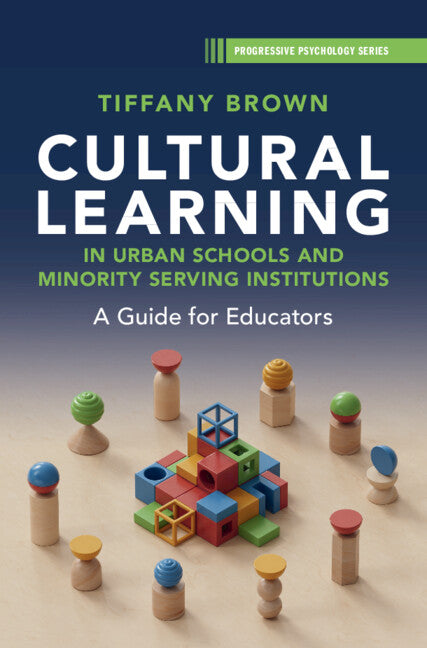
Cultural Learning in Urban Schools and Minority Serving Institutions
A Guide for Educators
Examines how K-16 educators learn across cultural differences between themselves and students from low-income and minoritized communities.
Tiffany Brown (Author)
9781009377041, Cambridge University Press
Hardback, published 3 April 2025
277 pages
23.6 x 15.9 x 2.2 cm, 0.56 kg
This book provides a comprehensive analysis of the social and organizational factors shaping K-16 teachers' cultural learning processes, through both a systematic review of the extant literature on K-12 urban teacher thinking and interviews with instructional staff at a high-performing minority serving institution (MSI). It highlights common challenges K-16 educators face in navigating cultural differences between themselves and their students. Drawing from cultural psychology, organizational behavior, and organizational psychology, the book offers evidence-based insights for creating school systems in which educators working with students from low-income and other minoritized cultural communities can critically examine and challenge their cultural assumptions to create more inclusive and supportive learning environments for all students, as well as develop and implement more culturally responsive classroom management practices.
Introduction: how cultural learning matters for educators everywhere
1. An action science approach to cultural learning in urban schools and minority serving institutions (MSIs)
2. Directly observable data on K-12 teachers in urban schools
3. Culturally accepted meanings and understandings K-12 educators accept about students from MCCs
4. Individual action strategies urban K-12 teachers use at work
5. Collective action strategies urban teachers use for cultural learning at work
6. Single-loop learning and double-loop learning conditions in urban schools
7. Implications from the systematic review for four types of cultural learning K-12 urban teachers engage in at work
8. Empirical research on college faculty thinking and action in MSIs
9. Faculty value orientations for single-loop learning and double-loop learning at work with students from LIMCCS
10. Consequences of model i and model ii values for learning across student–teacher cultural differences in MSIs
11. Faculty variance in use of traditional and culturally responsive classroom management strategies
12. Consequences of variance in use of traditional and culturally responsive classroom management strategies for learning across student–teacher differences in MSIs
13. Implications from the empirical data for instructor learning across cultures in MSIs
Conclusion: reconciling the knowing–doing gap for K-16 Educators in urban schools and MSIs.
Subject Areas: Educational psychology [JNC]