Freshly Printed - allow 6 days lead
Couldn't load pickup availability
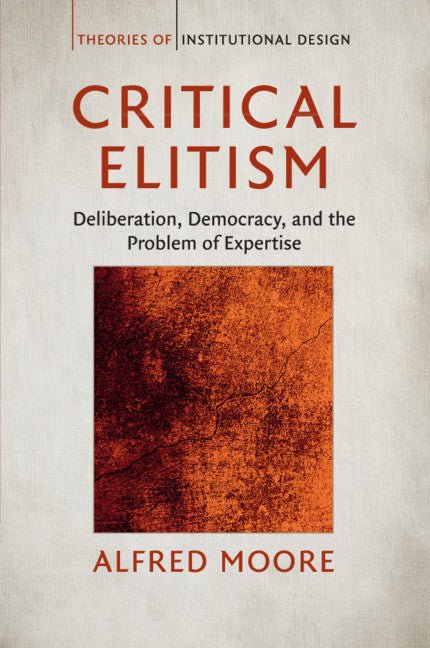
Critical Elitism
Deliberation, Democracy, and the Problem of Expertise
This book re-imagines expert authority for an age of critical citizens, and shows how expertise can contribute in a deliberative system.
Alfred Moore (Author)
9781316646250, Cambridge University Press
Paperback / softback, published 23 January 2020
223 pages, 1 b/w illus.
23 x 15.2 x 1.6 cm, 0.45 kg
'In this illuminating book, Alfred Moore argues persuasively that democracy requires not only active participation, but also reflective judgments about expert authority by those who choose not to participate. Critical Elitism offers a nuanced and important contribution to the study of expertise and democracy.' Mark B. Brown, California State University, Sacramento
Democracies have a problem with expertise. Expert knowledge both mediates and facilitates public apprehension of problems, yet it also threatens to exclude the public from consequential judgments and decisions located in technical domains. This book asks: how can we have inclusion without collapsing the very concept of expertise? How can public judgment be engaged in expert practices in a way that does not reduce to populism? Drawing on deliberative democratic theory and social studies of science, Critical Elitism argues that expert authority depends ultimately on the exercise of public judgment in a context in which there are live possibilities for protest, opposition and scrutiny. This account points to new ways of looking at the role of civil society, expert institutions, and democratic innovations in the constitution of expert authority within democratic systems. Using the example of climate science, Critical Elitism highlights not only the risks but also the benefits of contesting expertise.
Acknowledgements
Introduction
1. Two faces of epistemic democracy
2. Democracy and problem of expertise
3. Political and epistemic authority
4. The problem of judgment
5. Contestation
6. Consensus
7. Institutional innovations
Conclusion
References
Index.
Subject Areas: Political science & theory [JPA], Social & political philosophy [HPS]