Freshly Printed - allow 7 days lead
Couldn't load pickup availability
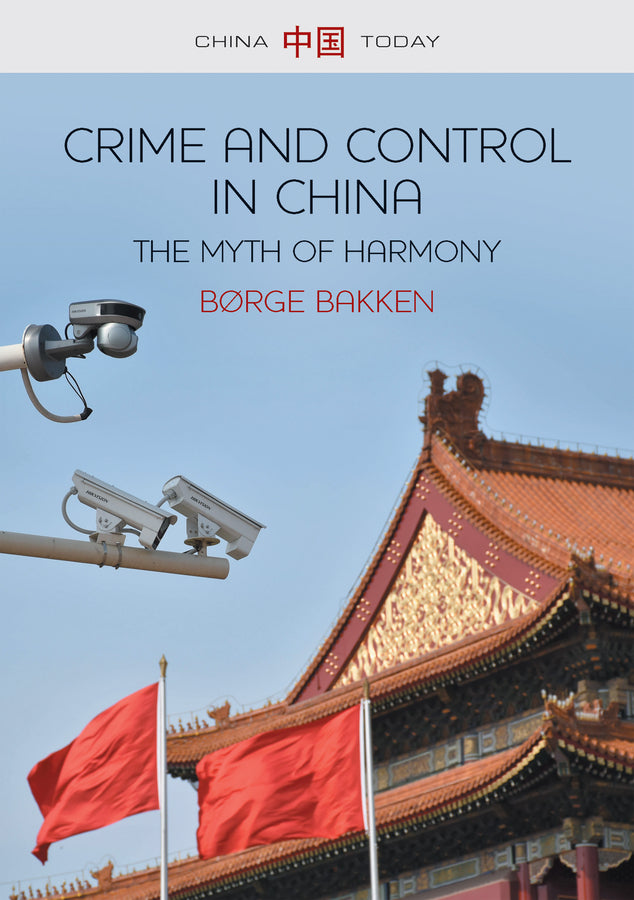
Crime and Control in China
The Myth of Harmony
Børge Bakken (Author)
9780745663173, Polity Press
Hardback, published 28 October 2022
256 pages
21.3 x 15.2 x 3.1 cm, 0.544 kg
"Børge Bakken’s incisive analysis reveals China as a far higher crime society than fraudulent statistics suggest. As we turn the pages of this sophisticated book, we grasp the evolution of a society where “the rich get richer and the poor get execution”. This is a monumental contribution to comprehending the devolution of despotism and dissent. What Bakken describes is a surveillance capitalist authoritarianism produced by a Chinese Communist Party that learned from Western tech corporations." "An engagingly written, evidence-based account that demolishes long-standing myths about the nature of crime and punishment in China, not least the regime's efforts to systematically hide the widespread violence and soaring crime rates that lurk behind one of the world’s most unequal societies." “The author skilfully supports his arguments with empirical data, including case studies, statistics and interviews, and presents his arguments in a balanced manner while maintaining a critical lens.”
John Braithwaite, University of Maryland
Frank Dikötter, University of Hong Kong
Preksha Shree Chhetri, Europe-Asia Studies
China is a transitional society with one of the highest inequality rates in the world. Criminologists would typify this as a highly toxic combination, creating very high levels of crime. Yet China reports extremely low crime rates. How might this be? With this book, Børge Bakken shows that the reality in China does not match the rosy picture of low crime and rule-by-law that the authorities present to the world. Looking beyond the statistics, Bakken discovers that violent crime is a particularly ‘sensitive issue’, deliberately censored by party propaganda and by an unaccountable police force that can ‘vanish’ any type of crime to a degree that makes a ‘crime rate’ a mere formality. As Bakken reveals, official Chinese crime statistics cannot be used to make assumptions about China's crime profile. Even the assumption that crime represents the problem and control its solution is not valid, Bakken argues. Because when control becomes part of the problem, the false assumption of a ‘harmonious society’ evaporates, rendering ‘harmony’ a myth and violence the traumatic reality. This meticulous investigation of crime and justice in China is crucial reading for those interested in the Chinese regime and China's state control, as well as criminologists and sociologists of crime.
Map
Chronology
Introduction
Shùzì / Numbers
1. The Manipulation of Chinese Crime Statistics
Chu ngsh ng / Trauma
2: The Historical Patterns of Crime, Violence, and Trauma
Páichì / Exclusion
3: Transition, Inequality, and Exclusion: Two Kinds of People
Ji nshì / Surveillance
4: Big Brother, Big Bucks, and Big Data: The Chinese Surveillance State
Yánlì / Harshness
5: ‘Hard Strikes’ and Moral Panics: The Craze of Anti-Crime Campaigns
Zhèngyì / Justice
6: Legal Hierarchies, Punitive Practices, and Changing Norms
7: Concluding Remarks
References
Subject Areas: Sociology & anthropology [JH]