Freshly Printed - allow 10 days lead
Couldn't load pickup availability
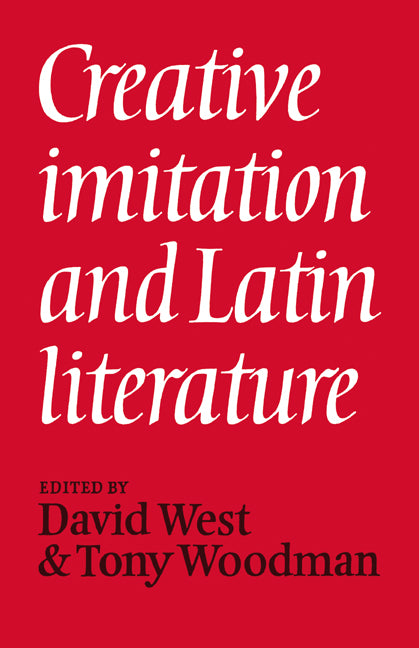
Creative Imitation and Latin Literature
The contributors analyse passages from various authors to demonstrate how Latin authors created new works of art by imitating earlier literature.
David West (Edited by), Tony Woodman (Edited by)
9780521036399, Cambridge University Press
Paperback / softback, published 7 May 2007
268 pages
21.6 x 14 x 1.6 cm, 0.356 kg
The poets and prose-writers of Greece and Rome were acutely conscious of their literary heritage. They expressed this consciousness in the regularity with which, in their writings, they imitated and alluded to the great authors who had preceded them. Such imitation was generally not regarded as plagiarism but as essential to the creation of a new literary work: imitating one's predecessors was in no way incompatible with originality or progress. These views were not peculiar to the writers of Greece and Rome but were adopted by many others who have written in the 'classical tradition' right up to modern times. Creative Imitation and Latin Literature is an exploration of this concept of imitation. The contributors analyse selected passages from various authors - Greek, Latin and English - in order to demonstrate how Latin authors created new works of art by imitating earlier passages of literature.
Prologue
1. De imitatione D. A. Russell
2. Plavtvs vortit barbare: Plautus, Bacchides 526–61 and Menander, Dis exapaton 102–12 David Bain
3. From Polyphemus to Corydon: Virgil, Eclogue 2 and the Idylls of Theocritus Ian M. Lem. Du Quesnay
4. Two plagues: Virgil, Georgics 3.478–566 and Lucretius 6.1090–1286 David West
5. Horatian imitatio and odes 2.5 C. W. Macleod
6. Ivdicivm transferendi: Virgil, Aeneid and 2.469–505 and its antecedents E. J. Kenney
7. Self-imitation within a generic framework: Ovid, Amores 2.9 and 3.11 and the renuntiatio amoris Francis Cairns
8. Self-imitation and the substance of history: Tacitus, Annals 1.61–5 and Histories 2.70, 5.14–15 Tony Woodman
9. Lente cvrrite, noctis eqvi: Chaucer, Troilus and Criseyde 3.1422–70, Donne, The Sun Rising and Ovid, Amores 1.13 K. W. Gransden
10. Pyramus and Thisbe in Shakespeare and Ovid: A Midsummer Night's Dream and Metamorphoses 4.1–166 Niall Rudd
11. Epilogue
Notes
Abbreviations and bibliography
Select indexes.
Subject Areas: Literary studies: classical, early & medieval [DSBB], Literary essays [DNF]