Freshly Printed - allow 10 days lead
Couldn't load pickup availability
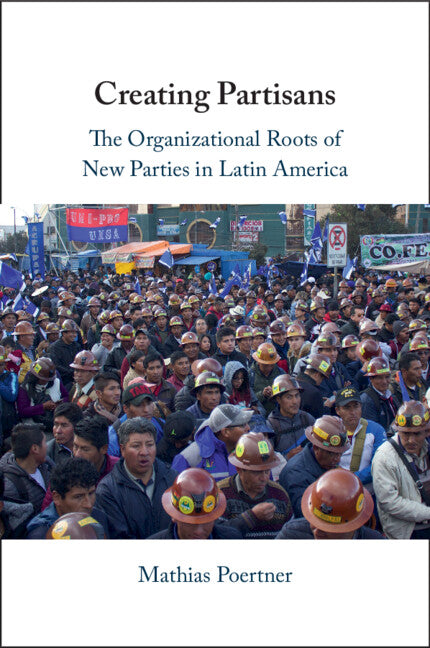
Creating Partisans
The Organizational Roots of New Parties in Latin America
Explores why some political parties are successful in creating partisanship and securing electoral support, while most fail and disappear.
Mathias Poertner (Author)
9781009446280, Cambridge University Press
Paperback / softback, published 28 November 2024
272 pages
22.8 x 15.1 x 1.6 cm, 0.4 kg
'How do new parties engender mass support? Received wisdom, including theories of childhood partisan socialization, cannot tell us the answer. Poertner develops a rich and highly convincing account of the effectiveness of voter appeals that are mediated by societal organizations. Leveraging comparative case studies of new parties in Bolivia, Ecuador, and Mexico, and highly original survey and natural experiments, Poertner provides striking new answers to a critical question for democratic politics.' Thad Dunning, Robson Professor of Political Science, University of California, Berkeley
Why are some new political parties successful at creating mass partisanship and engendering stable electoral support, while most fail to take root in society and disappear quickly? Creating Partisans unveils the secrets behind successful political parties, taking a deep dive into the formation and success of new political parties in Latin America. Based on extensive fieldwork and using a multi-method approach, the book explores how different mobilization strategies sway voters to support new parties. While prior studies have focused on the various types of direct appeals parties make to voters, Creating Partisans reveals that it is organizationally mediated appeals – those that engage voters through locally-based civil society organizations – that can secure electoral support more effectively and can create lasting partisan attachments. From indigenous organizations to informal sector unions, new types of societal organizations play a critical mediating role in shaping electoral outcomes and fostering long-term partisan loyalties in young democracies.
List of figures
List of tables
Acknowledgments
1. Introduction: the organizational roots of new parties
2. Explaining mass support for new parties
Part I. Development of Mobilization Strategies: 3. Mediated appeals through peak associations: MAS in Bolivia
4. Direct appeals: Alianza PAIS in Ecuador
5. Mediated appeals through local associations: MORENA in Mexico
Part II. Implications for Mass Support: 6. Mechanisms of electoral support: Bolivia and Ecuador
7. Resulting electoral support: Mexico
8. Resulting party identification: Bolivia, Ecuador, and Mexico
9. Conclusion: New parties, Societal organizations, and democracy
Bibliography.
Subject Areas: Comparative politics [JPB]