Freshly Printed - allow 10 days lead
Couldn't load pickup availability
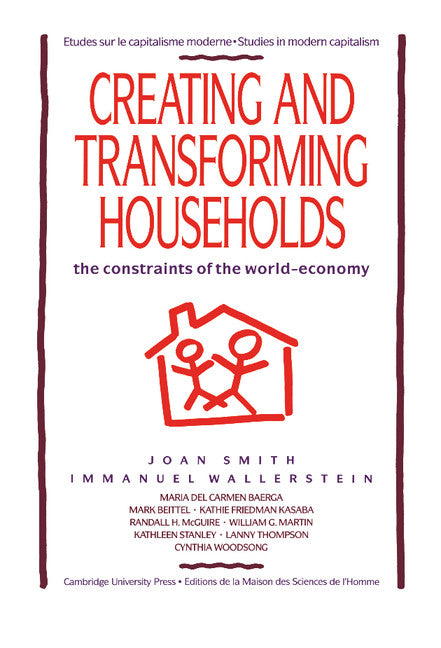
Creating and Transforming Households
The Constraints of the World-Economy
A systematic and original approach to the intimate link between the micro-structures of households and the structures of the capitalist world-economy.
Joan Smith (Author), Immanuel Wallerstein (Author), Maria del Carmen Baerga (Contributions by), Mark Beittel (Contributions by), Kathie Friedman Kasaba (Contributions by), Randall H. McGuire (Contributions by), William G. Martin (Contributions by), Kathleen Stanley (Contributions by), Lanny Thompson (Contributions by), Cynthia Woodsong (Contributions by)
9780521415521, Cambridge University Press
Hardback, published 27 August 1992
320 pages, 16 tables
23.5 x 15.9 x 2.3 cm, 0.579 kg
"This book is a useful sourcebook for those interested iin the specific regions of the world it covers. Perhaps more importantly, it provides empirical evidence to confirm that even in the United States, the classic Fordist worker has existed only during very short periods, while the economic contribution of other members of the household has always been a crucial factor in their reproduction." Belinda Leach, Canadian Review of Sociology and Anthropology
This book, first published in 1992, seeks an explanation of the pattern of sharp discrepancy of wage levels across the world-economy for work of comparable productivity. It explores how far such differences can be explained by the different structures of households as 'income-pooling units', examining three key variables: location in the core or periphery of the world-economy; periods of expansion versus periods of contraction in the world-economy; and secular transformation over time. The authors argue that both the boundaries of households and their sources of income are molded by the changing patterns of the world-economy, but are also modes of defense against its pressures. Drawing empirical data from eight local regions in three different zones - the United States, Mexico and southern Africa - this book presents a systematic and original approach to the intimate link between the micro-structures of households and the structures of the capitalist world-economy at a global level.
Preface Joan Smith and Immanuel Wallerstein
1. Household as an institution of the world-economy Immanuel Wallerstein and Joan Smith
2. The United States Kathie Friedman Kasada
(a) The Detroit Story: the crucible of Fordism Kathleen Stanley and Joan Smith
(b) New York City: the underside of the world's capital Kathie Friedman Kasada
(c) Binghamton: the secrets of a backwater Randall H. McGuire and Cynthia Woodsong
(d) Puerto Rico: from colony to colony Maria Del Carmen Baega
3. Mexico Lanny Thompson
(a) Mexico City: the slow rise of wage-centered households Lanny Thompson
(b) Central Mexico: the decline of subsistence and the rise of poverty Lanny Thompson
4. Southern Africa Mark Beittel
(a) The Witwatersrand: black households, white households Mark Beittel
(b) Lesotho: the creation of the households William G. Martin
5. Core-periphery and household structures Immanuel Wallerstein and Joan Smith
Postscript on method Joan Smith and Jamie Sudler
Bibliography.
Subject Areas: Labour economics [KCF]