Freshly Printed - allow 7 days lead
Couldn't load pickup availability
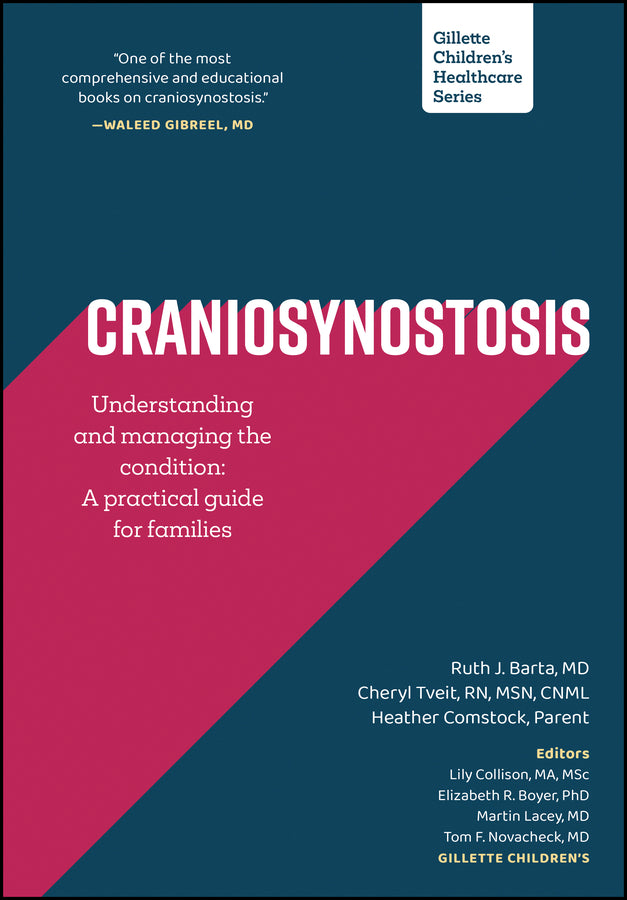
Craniosynostosis – Understanding and managing the condition – A practical guide for families
A Practical Guide for Families
RJ Barta (Author)
9781952181092, Wiley
Paperback / softback, published 12 November 2024
248 pages
24.3 x 17 x 2.3 cm, 0.53 kg
Craniosynostosis is a condition where the bones of an infant’s skull fuse together too early. In most cases, surgery in the first year of life will effectively correct it and the child can go on to expect a typical life. For a minority, craniosynostosis is part of a syndrome, which is a lifelong condition. This practical guide explains how craniosynostosis develops and the evidence-based, best-practice treatments. It also includes the lived experience of families. The writing of Craniosynostosis was led by Dr. Ruth Barta, MD, Craniofacial and Pediatric Plastic Surgeon at Gillette Children’s, a world-renowned center of excellence for the treatment of brain, bone, and movement conditions. Craniosynostosis is part of the Gillette Children's Healthcare Series, a series of books for families who are looking for clear, comprehensive information. Health care professionals, educators, students, and extended family members will also benefit from reading Craniosynostosis. Other titles in the series include:
Author and Editors Series Foreword Series Introduction Craniosynostosis Introduction Typical brain and skull development Classifications of craniosynostosis Prevalence, causes and risk factors, and symptoms Diagnosis Why treatment is important Best practice Key points Chapter 1 Nonsyndromic craniosynostosis Introduction Sagittal CS Metopic CS Coronal CS Lambdoid CS Cognition, behavior, speech, and language Key points Chapter 2 Syndromic craniosynostosis Introduction CS syndromes Prevalence and genetics Head characteristics Additional characteristics Airway, feeding and eye closure Cognition, behavior, speech, and language Key points Chapter 3 Surgical management and treatment in infancy 4.1 Introduction 4.2 Preparing for surgery 4.3 Surgical repair 4.4 Recovering from surgery Key points Chapter 4 Deformational plagiocephaly Introduction Causes and risk factors Treatment Key points Chapter 5 Growing up with nonsyndromic craniosynostosis Introduction Additional surgery Key points Chapter 6 Growing up with syndromic craniosynostosis Introduction Additional surgery Key points Chapter 7 Living with craniosynostosis Further Reading and involvement in research Acknowledgments Glossary References Index
Subject Areas: Clinical & internal medicine [MJ]