Freshly Printed - allow 10 days lead
Couldn't load pickup availability
Courting Democracy in Bosnia and Herzegovina
This study shows the impact of the ICTY on Bosnian society and its role in translating international law in domestic contexts.
Lara J. Nettelfield (Author)
9781107610606, Cambridge University Press
Paperback / softback, published 29 October 2012
362 pages, 19 b/w illus. 1 map 12 tables
22.9 x 15.2 x 1.9 cm, 0.5 kg
'Nettelfield is to be commended on the intrinsic details that she provides about cases she discusses while trying to develop an overall picture of the issue at hand … the originality of this comparative analysis, abundant in empirical proof, stands out in three ways: in the field of research, in the focus of the researched parameters and in the complex methodology.' Vanja Petrièeviæ, Europe-Asia Studies
The International Criminal Tribunal for the former Yugoslavia (ICTY) struggled to apprehend and try high-profile defendants including Serbian leader Slobodan Milošević, often receiving more criticism than praise. This volume argues that the court has made a substantial contribution to Bosnia and Herzegovina's transition to democracy. Based on over three years of field research and several hundred interviews, this study brings together multiple research methods - including surveys, ethnography and archival materials - to show the court's impact on five segments of Bosnian society, emphasizing the role of the social setting in translating international law into domestic contexts. Much of the early rhetoric about the transformative potential of international criminal law fostered unrealistic expectations of institutions like the ICTY. Judged by more realistic standards, international law is seen to play a modest yet important role in postwar transitions. These findings have implications for the study of international courts around the world and the role of law in contributing to social change.
1. Assessing the impact: Bosnia and Herzegovina and the International Criminal Tribunal for the former Yugoslavia (ICTY)
2. Crafting the polity: transitional justice and democratization in Bosnia and Herzegovina
3. An unfavorable context: war, Dayton, and the ICTY
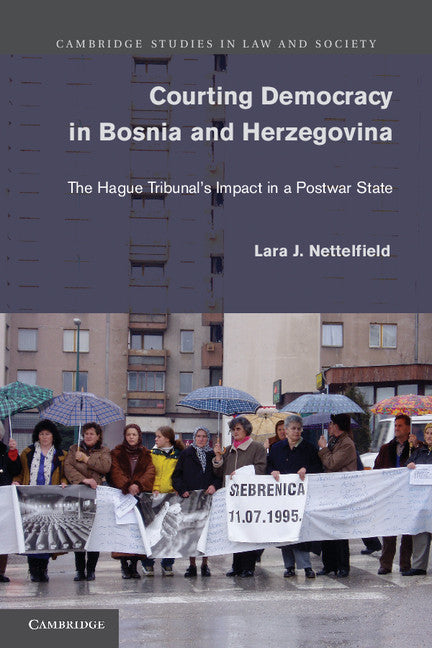
4. Expanding the norm of accountability: Srebrenica's survivors, collective action, and the ICTY
5. Making progress with few resources: civil society and the ICTY
6. Narrative and counter-narrative: the case of the Čelebići trial
7. From the battlefield to the barracks: the ICTY and the Bosnian armed forces (AFBIH)
8. Localizing war crimes prosecutions: the Hague to Sarajevo and beyond
9. Conclusion.
Subject Areas: International organisations & institutions [LBBU], International relations [JPS]