Freshly Printed - allow 10 days lead
Couldn't load pickup availability
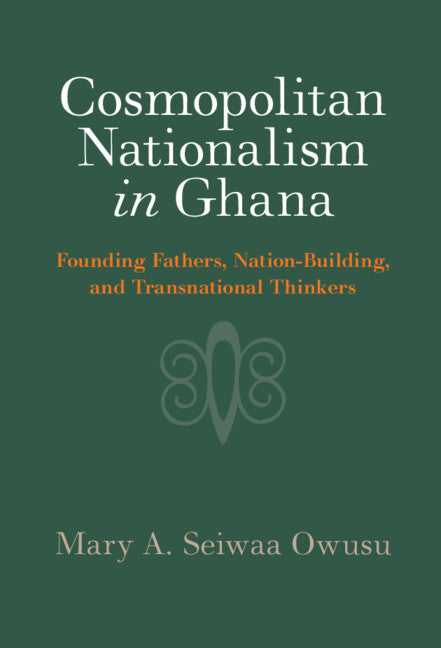
Cosmopolitan Nationalism in Ghana
Founding Fathers, Nation-Building, and Transnational Thinkers
Examines how West African writer-intellectuals harnessed Atlantic networks to explore ideas of race, regeneration, and nation-building.
Mary A. Seiwaa Owusu (Author)
9781009524667, Cambridge University Press
Hardback, published 19 December 2024
314 pages
23.5 x 15.9 x 2.3 cm, 0.6 kg
'Owusu identifies weaknesses with the enduring habit of reducing Ghana's modern intellectual history to the rise of nationalism, revealing how this fails to capture the far richer nature of Ghanaian intellectuals' enterprise. She provokes us to construct this history very differently, while providing concepts suited to the task.' Philip Zachernuk, Dalhousie University
Nineteenth and twentieth-century West African writer-intellectuals harnessed their Atlantic networks to explore ideas of race, regeneration, and nation-building. Yet, the ultimately cosmopolitan nature of these political and intellectual pursuits has been overlooked by dominant narratives of anti-colonial history. In contrast, Cosmopolitan Nationalism in Ghana uses cosmopolitanism as a primary theoretical tool, interrogating the anti-colonial writings that prop up Ghana's nationalist history under a new light. Mary A. Seiwaa Owusu highlights the limitations of accepted labels of nationalist scholarship and confirms that these writer-intellectuals instead engaged with ideas around the globe. This study offers a more complex account of the nation-building project, arguing for the pivotal role of other groups and factors in addition to Kwame Nkrumah's leadership. In turn, it proposes a historical account which assumes a cosmopolitan setting, highlights the centrality of debate, and opens a vista for richer understandings of Ghanaians' longstanding questions about thriving in the world.
Introduction
1. Ghana's grand narrative
2. Rethinking proto nationalism Blyden and Horton (1863–1912)
3. Rethinking cultural nationalism as debates on synthesis (1887–1920)
4. Misreading conservative nationalism (1920–1945)
5. Rethinking the monopoly of radical nationalism (1946–1958)
Conclusion
Bibliography
Index.
Subject Areas: African history [HBJH]