Special Order - allow 2+ weeks lead
Couldn't load pickup availability
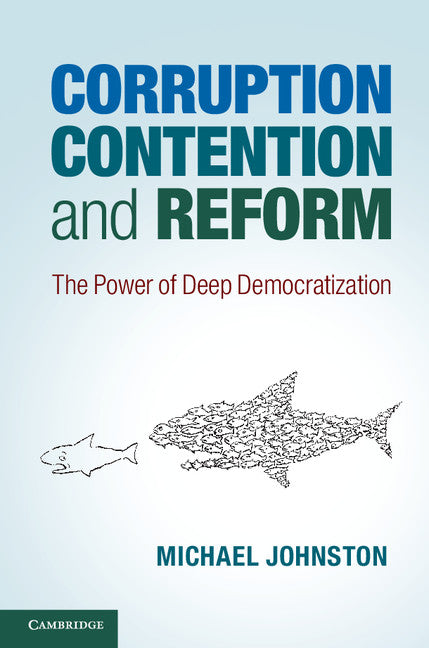
Corruption, Contention, and Reform
The Power of Deep Democratization
Explores four types of corruption and the implications for reform, emphasizing practical ways to check abuses of wealth and power.
Michael Johnston (Author)
9781107610064, Cambridge University Press
Paperback / softback, published 12 December 2013
308 pages, 2 b/w illus. 7 tables
22.8 x 15.2 x 1.7 cm, 0.46 kg
'This important sequel builds on Johnston's previous book Syndromes of Corruption to develop reform agendas for his four regimes: official moguls, oligarchs and clans, elite cartels, and influence markets. Although he stresses the diversity of corrupt scenarios, his major innovation is the unifying concept of 'deep democratization', a political structure where citizens can check abuses of wealth and power.' Susan Rose-Ackerman, Yale University
Michael Johnston argues that corruption will persist, and even be the rule rather than the exception, until those with a stake in ending it can act in ways that cannot be ignored. This is the key principle of 'deep democratization', enabling citizens to defend their interests by political means. The author analyses four syndromes of corruption in light of this principle: official moguls in Egypt and Tunisia, oligarchs and clans in the Philippines, elite cartels in Argentina, and influence markets in France, Australia and the US. Johnston argues that different kinds of corruption require distinctive responses, each bearing specific risks. Focusing on recent events, including the global economic crisis and the Arab Spring, he shows that we can assess vulnerabilities to corruption and the effects of reforms, and use this information to identify new practices. His book offers a fundamental reappraisal of ways to check abuses of wealth and power.
Preface
1. Reform in an imperfect world
2. 'Deep democratization' and the control of corruption
3. First, do no harm - then, build trust: reform in fragile and post-conflict societies
4. Official moguls: power, protection … and profits
5. Oligarchs and clans: high stakes and insecurity
6. Elite cartels: hanging on with a little help from my friends
7. Influence market corruption: wealth and power versus justice
8. Staying power: building and sustaining citizen engagement
Appendix: recognizing the syndromes of corruption.
Subject Areas: Political economy [KCP], Development economics & emerging economies [KCM], Comparative politics [JPB], Sociology [JHB]