Freshly Printed - allow 5 days lead
Couldn't load pickup availability
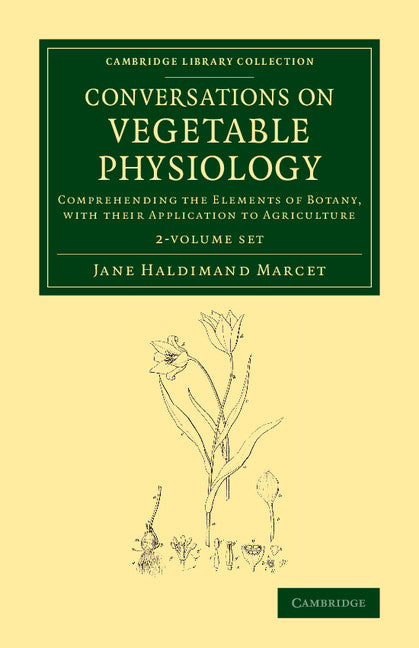
Conversations on Vegetable Physiology 2 Volume Set
Comprehending the Elements of Botany, with their Application to Agriculture
Published in 1829, this two-volume work, a beginner's guide to botany, deals with plant form and plant science's practical applications.
Jane Haldimand Marcet (Author)
9781108067478, Cambridge University Press
Multiple-component retail product, published 21 November 2013
642 pages, 4 b/w illus.
22.4 x 14.2 x 4.1 cm, 0.82 kg
Jane Haldimand Marcet (1769–1858) wrote across a range of topics, from natural philosophy to political economy. Her educational books were especially intended for female students, to combat the prevalent idea that science and economics were unsuitable for women, but they found broader popularity: Michael Faraday, as a young bookbinder's apprentice, credited Marcet with introducing him to electrochemistry. This two-volume work, first published in 1829, is a beginner's guide to botany. Since the chief aim was accessibility, Marcet does not dwell on the often burdensome process of plant classification, but focuses on plant forms and botany's practical applications. She presents the facts in the form of simple conversations between two students and their teacher. Based on the lectures of the Swiss botanist Candolle, Volume 1 introduces roots, leaves, sap, and the effects of different soil and air. Volume 2 considers agriculture and plant diseases, the cultivation of trees and culinary vegetables, and the effects of humans on flora.
Volume 1: Preface
1. Introduction
2. On roots
3. On stems
4. On leaves
5. On sap
6. On cambium, and the peculiar juices of plants
7. On the action of light and heat on plants
8. On the naturalisation of plants
9. On the action of the atmosphere on plants
10. On the action of water on plants
11. On the artificial modes of watering plants
12. On the action of soil on plants
13. The action of soil on plants continued
14. The action of soil on plants continued. Volume 2: 15. On the multiplication of plants by subdivision
16. On grafting
17. On the multiplication of plants by seed
18. On compound flowers
19. In fruit
20. On the seed
21. On the classification of plants
22. On artificial systems of classification of plants
23. On the natural systems of classification
24. On botanical geography
25. On the influence of culture on vegetation
26. On the degeneration and the diseases of plants
27. The diseases of plants continued
28. On the cultivation of trees
29. On the cultivation of plants which produce fermented liquors
30. On the cultivation of grasses, tuberous roots, and grain
31. On oleaginous plants and culinary vegetables.
Subject Areas: Botany & plant sciences [PST]