Freshly Printed - allow 7 days lead
Couldn't load pickup availability
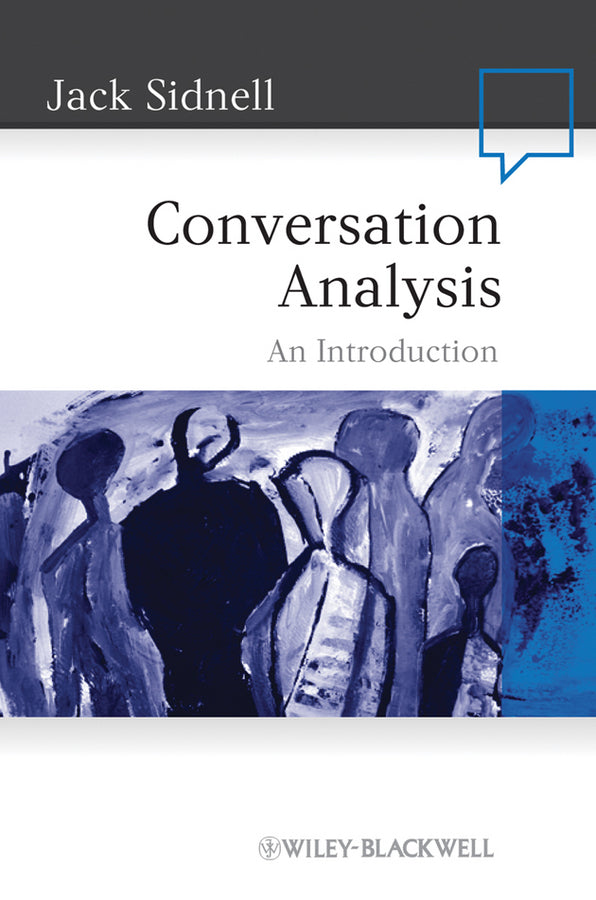
Conversation Analysis
An Introduction
"This book is an excellent text to introduce students to conversation analysis, situating it historically and with reference to other approaches to human language behavior. Sidnell uses insightful explanations of examples of spoken interactions to present a comprehensive and well-integrated overview of concepts and methods in the field." “This is a comprehensive, authoritative yet accessible introduction to Conversation Analysis. Sidnell captures so well both the analytic mentality of CA, and the complexity and sheer contingency of ordinary conversation.”
—Elaine Vine, Victoria University of Wellington
—Paul Drew, University of York
Jack Sidnell (Author)
9781405159005, Wiley
Hardback, published 16 April 2010
304 pages
25.4 x 18 x 2.1 cm, 0.685 kg
“Overall, I was very favorably impressed by Conversation Analysis: An Introduction . . . n its own terms, I “To conclude, this introduction is a rich source of authentic examples and will serve interested students and scholars very well.” (Discourse and Communication, 1 November 2012) "The interdisciplinary research method and field of conversation analysis (CA) is remarkably well-suited to helping teachers achieve this objective, because CA provides tools that enable first the perception, and then the scientific description and analysis of regular patterns of human social conduct - patterns that organize, and make meaningful, the world of everyday life." (Language in Society, 2011)
particularly liked the straightforward, accessible style that Sidnell uses to discuss complex ideas and materials.” (Journal of Sociolinguistics, 1 February 2013)
Combining the main findings, methods and analytic techniques of this central approach to language and social interaction, along with real-life examples and step-by-step explanations, Conversation Analysis is the ideal student guide to the field.
Acknowledgements vii Transcription Conventions ix 1 Talk 1 2 Methods 20 3 Turn-Taking 36 4 Action and Understanding 59 5 Preference 77 6 Sequence 95 7 Repair 110 8 Turn Construction 139 9 Stories 174 10 Openings and Closings 197 11 Topic 223 12 Context 245 13 Conclusion 258 References 271 Index 281
Subject Areas: Linguistics [CF]