Special Order - allow 2+ weeks lead
Couldn't load pickup availability
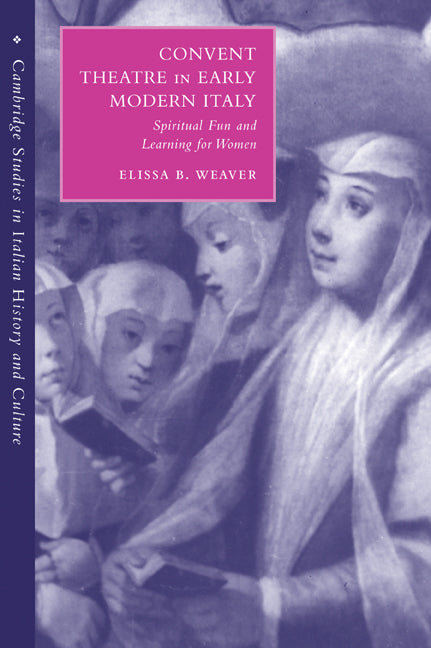
Convent Theatre in Early Modern Italy
Spiritual Fun and Learning for Women
A pioneering study of all-female convent theatre in early modern Italy.
Elissa B. Weaver (Author)
9780521039024, Cambridge University Press
Paperback / softback, published 16 August 2007
324 pages, 17 b/w illus.
22.8 x 15.1 x 1.6 cm, 0.488 kg
'Weaver's book restores to an unself-consciously masculinist literary history both a vivid sense of theatrical practice as intrinsic to the community life of monastic women, and a sharply focused understanding of how monastic women playwrights in the sixteenth and seventeenth centuries represented their own and laywomen's experiences of a gendered world.' Journal of Early Music History
This book is a study of convent theatre in Italy, an all-female tradition. Widespread in the early modern period, but virtually forgotten today, this activity produced a number of talented dramatists and works worthy of remembrance. Convent authors, actresses and audiences, especially in Tuscan houses, the plays written and produced, and what these reveal about the lives of convent women, are the focus of this book. Beginning with the earliest known performances of miracle and mystery plays (sacre rappresentazioni) in the late fifteenth century, the book follows the development in the convents at the turn of the sixteenth century of spiritual comedy and of a variety of dramatic forms in the seventeenth century. Convent theatre both reflected the high level of literacy among convent women and contributed to it, and it attested to the continuing close contact between the secular world and the convents - even in the Post Tridentine period.
List of illustrations
Acknowledgements
List of abbreviations
Notes on texts and translations
Introduction
1. Renaissance culture in Italian convents, 1450–1650
2. The convent theatre tradition
3. Plays and playwrights: the earliest examples
4. Spiritual comedies in the convents
5. From manuscript to print, from the convent to the world
6. Beyond Tuscany
Conclusion
Appendix
Bibliography
Index.
Subject Areas: Gender studies: women [JFSJ1], Early modern history: c 1450/1500 to c 1700 [HBLH], European history [HBJD], Theatre studies [AN]