Freshly Printed - allow 7 days lead
Couldn't load pickup availability
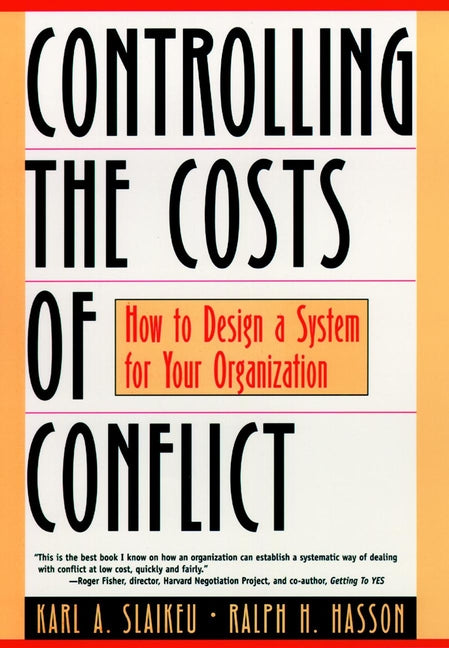
Controlling the Costs of Conflict
How to Design a System for Your Organization
Karl A. Slaikeu (Author), Ralph H. Hasson (Author)
9780787943233, Wiley
Paperback / softback, published 30 October 1998
256 pages
23.3 x 15.9 x 2.1 cm, 0.46 kg
"Slaikeu and Hasson have outlined a thoughtful and accessibleconflict resolution blueprint for those companies that seek to beamong the employers of choice in the next century." --Wilbur Hicks,ombudsman, Shell Oil Company
"Slaikeu and Hasson, who are practitioners as well as researchers,are for real. This systems-design book--finally--is about the nutsand bolts of what really has to be in a system. The checklists andbest-practice summaries will be helpful to all managers, and toeveryong who thinks about organizations in a systematic way."--Mary Rowe, MIT ombudsperson, and adjunct professor of negotiationand conflict management, MIT Sloan School of Management
"Anyone interested in better understanding how to control the costsof conflict will find this book of significant value." --BenjaminW. Heineman Jr., senior vice president, general counsel andsecretary, General Electric
Written for non-experts in jargon-free language, this work shows how to create systems within organizations that preempt the monetary, strategic, and emotional costs associated with on-the-job conflict. Its clear and simple approach translates advanced concepts into practical how-tos and provides readers with four guiding principles they can follow to create conflict control systems of their own. Amply illustrated with real-world examples, it details the policies, procedures, and practices that make for successful control systems and tells precisely how to implement them.
Introduction.
The Hidden Culprit of High Costs: Weak Systems.
First Principle: Acknowledge Four Ways to Resolve Conflict.
Defining Four Options.
Weighing Costs and Risks of Each Method.
Choosing an Approach to Conflict Management.
The Preferred Path for Cost Control.
Second Principle: Create Options for Prevention and EarlyIntervention.
A Template for All Organizations.
Applying the Template: Real Stories.
Third Principle: Build Collaborative Strength Through SevenCheckpoints.
Seven Checkpoints.
Clarify Policy.
Define Roles and Responsibilities.
Revise Documents.
Establish Selection Criteria.
Provide Education and Training.
Strengthen Support Systems.
Evaluate the System.
Fourth Principle: Use the Mediation Model to Build Cosensus AmongDecision Makers and Users.
Assumptions About Change.
Phase One: Draft a Blueprint.
Phase Two: Implement the Plan.
Phase Three: Review the System Annually.
Conclusion.
Conclusion: A Vision for Your Organization.
Resource A: Glossary.
Resource B: Ombudsman Code of Ethics and Standard Practices.
Resource C: Skills Courses.
Subject Areas: Business & management [KJ]