Freshly Printed - allow 7 days lead
Couldn't load pickup availability
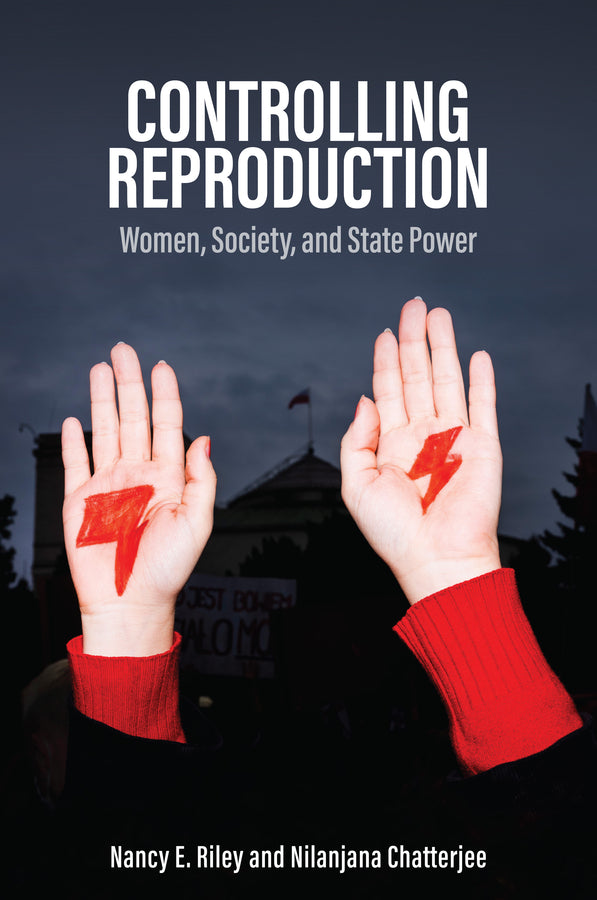
Controlling Reproduction
Women, Society, and State Power
Nancy E. Riley (Author), Nilanjana Chatterjee (Author)
9781509539918, Polity Press
Hardback, published 25 November 2022
224 pages
23.1 x 15.8 x 2.5 cm, 0.522 kg
"Struggles over reproduction have rarely been more intense for women, communities, and institutions. Riley and Chatterjee combine rigor and creativity to connect real-world control and resistance with feminist works of speculative fiction. Their tour de force provokes profound reflection on current social life and possible future worlds." "Riley and Chatterjee provide a comprehensive overview of reproductive battles playing out locally and internationally, highlighting that reproductive control is about controlling women, but also about defining economic, political, and social boundaries. They insightfully analyze the interplay between the most intimate individual concerns and institutional and government structures." "I found this a fascinating book[. ... A] highly significant contribution to the sexual and reproductive health literature, giving a deep and nuanced overview of the subject."
—Elizabeth Krause, University of Massachusetts, Amherst
—Caitlin Killian, Drew University
—Sexual and Reproductive Health Matters
“Describing the policies of different countries, Riley and Chatterjee repeatedly justify their thesis: everything revolves around reproduction.”
—iz3w
Controlling reproduction – who has children, how many, and when – is important to states, communities, families, and individuals across the globe. However, the stakes are even higher than might at first be appreciated: control over reproduction is an incredibly powerful tool. Contests over reproduction necessarily involve control over women and their bodies. Yet because reproduction is so intertwined with other social processes and institutions, controlling it also extends far into most corners of social, economic, and political life. Nancy Riley and Nilanjana Chatterjee explore how various social institutions beyond the individual – including state, religion, market, and family – are involved in the negotiation of reproductive power. They draw on examples from across the world, such as direct fertility policies in China and Romania, the influence of the Catholic Church in Poland and Brazil, racial discrimination and resistance in Mexico and the US, and how Japan and Norway use laws intended to encourage gender equality to indirectly shape reproduction. This engaging book sheds new light on the operations of power and gender in society. It will appeal to students taking courses on reproduction in departments of sociology, anthropology, and gender studies.
Chapter 1: Introduction: Controlling Women, Controlling Reproduction Chapter 2: Direct State Control of Reproduction Chapter 3: Religion and the State Chapter 4: State and Family: Cooperation and Contestation Chapter 5: State Management of Reproduction in the Making and Unmaking of Communities Chapter 6: Control of Reproduction in a Neoliberal World Chapter 7: The Global Interconnections of Reproscapes Chapter 8: Looking Ahead
Subject Areas: Sociology & anthropology [JH]