Special Order - allow 2+ weeks lead
Couldn't load pickup availability
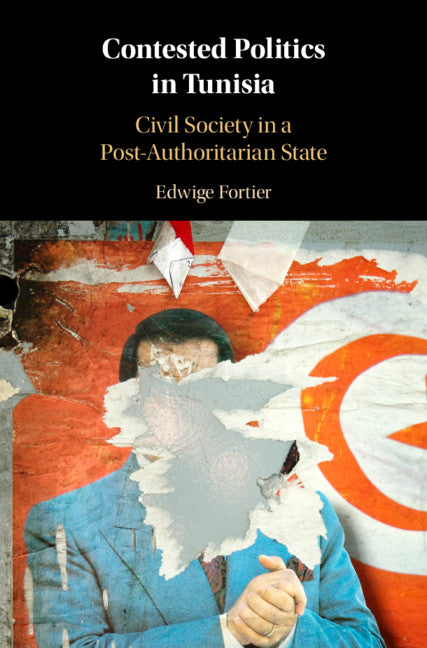
Contested Politics in Tunisia
Civil Society in a Post-Authoritarian State
Through the lens and experiences of civil society, Fortier demonstrates the volatility of democratization following the downfall of Tunisia's authoritarian regime duringin the 2010–11 uprisings.
Edwige Fortier (Author)
9781108425322, Cambridge University Press
Hardback, published 30 May 2019
250 pages
23.4 x 15.5 x 1.8 cm, 0.48 kg
'This study establishes the falsity of the neoliberal doxa's view of 'civil society' as homogeneously dedicated to 'good governance'. Through the litmus tests of three different NGO standpoints - human rights, sexual freedom, and faith - Edwige Fortier effectively shows how only a disparate and conflictive civil society can be the hallmark of democracy.' Gilbert Achcar, School of Oriental and African Studies, University of London and author of The People Want: A Radical Exploration of the Arab Uprising
Several thousand new civil society organisations were legally established in Tunisia following the 2010–11 uprising that forced the long-serving dictator, Zine al-Abidine Ben Ali, from office. These organisations had different visions for a new Tunisia, and divisive issues such as the status of women, homosexuality, and human rights became highly contested. For some actors, the transition from authoritarian rule allowed them to have a strong voice that was previously muted under the former regimes. For others, the conflicts that emerged between the different groups brought new repressions and exclusions – this time not from the regime, but from 'civil society'. Vulnerable populations and the organisations working with them soon found themselves operating on uncertain terrain, where providing support to marginalised and routinely criminalised communities brought unexpected challenges. Here, Edwige Fortier explores this remarkable period of transformation and the effects of opening up public space in this way.
1. Introduction: in the pursuit of dignity and freedom
2. Situating civil society: emancipation or liberalization
3. The consolidation of the Tunisian state
4. Civil society and the opening up of the public space
5. Social divisions and the re-manifestation of social Islam
6. Consensus and marginalization: the mapping of priorities in post-uprising Tunisia
7. Conclusion: imagining change – determining the parameters of pluralism.
Subject Areas: Revolutionary groups & movements [JPWQ], Non-governmental organizations [NGOs JPWH], Regional government [JPR], Politics & government [JP], Middle Eastern history [HBJF1], Regional & national history [HBJ], History [HB]