Freshly Printed - allow 7 days lead
Couldn't load pickup availability
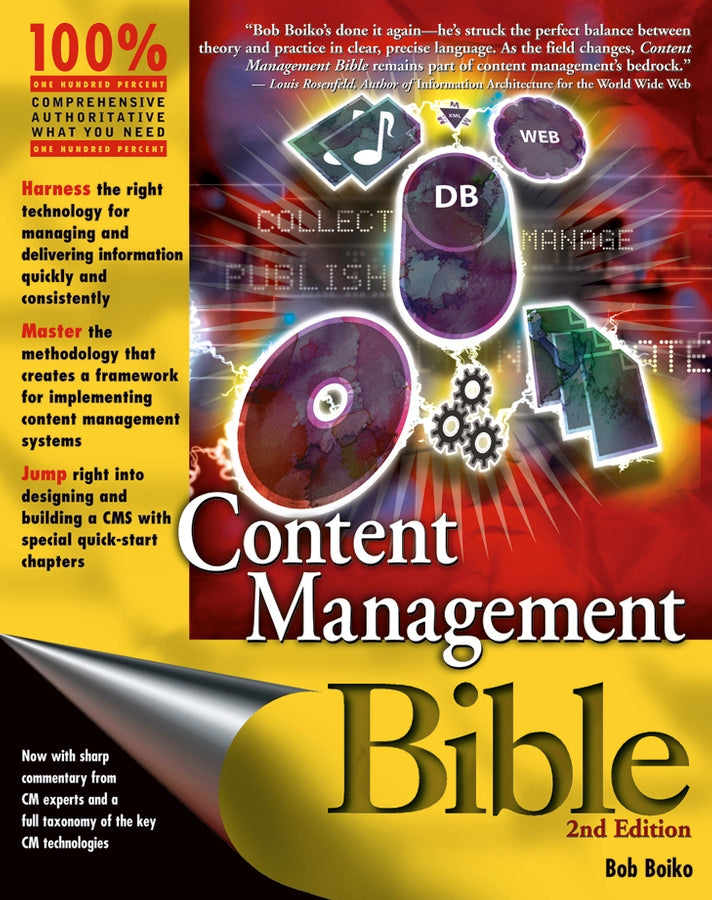
Content Management Bible
Bob Boiko (Author)
9780764573712, Wiley
Paperback / softback, published 26 November 2004
1176 pages
23.4 x 18.8 x 5.8 cm, 1.52 kg
Foreword. Preface. Acknowledgments. Introduction. Part I: What Is Content? Chapter 1: Defining Data, Information, and Content. Chapter 2: Content Has Format. Chapter 3: Content Has Structure. Chapter 4: Functionality Is Content, Too! Chapter 5: But What Is Content Really? Part II: What Is Content Management? Chapter 6: Understanding Content Management. Chapter 7: Introducing the Major Parts of a CMS. Chapter 8: Knowing When You Need a CMS. Chapter 9: Component Management versus Composition Management. Chapter 10: The Roots of Content Management. Chapter 11: The Branches of Content Management. Part III: Doing Content Management Projects. Chapter 12: Doing CM Projects Simply. Chapter 13: Staffing a CMS. Chapter 14: Working within the Organization. Chapter 15: Getting Ready for a CMS. Chapter 16: Securing a Project Mandate. Chapter 17: Doing Requirements Gathering. Chapter 18: Doing Logical Design. Chapter 19: Selecting Hardware and Software. Chapter 20: Implementing the System. Chapter 21: Rolling Out the System. Part IV: Designing a CMS. Chapter 22: Designing a CMS Simply. Chapter 23: The Wheel of Content Management. Chapter 24: Working with Metadata. Chapter 25: Cataloging Audiences. Chapter 26: Designing Publications. Chapter 27: Designing Content Types. Chapter 28: Accounting for Authors. Chapter 29: Accounting for Acquisition Sources. Chapter 30: Designing Content Access Structures. Chapter 31: Designing Templates. Chapter 32: Designing Personalization. Chapter 33: Designing Workflow and Staffing Models. Part V: Building a CMS. Chapter 34: Building a CMS Simply. Chapter 35: What Are Content Markup Languages? Chapter 36: XML and Content Management. Chapter 37: Processing Content. Chapter 38: Building Collection Systems. Chapter 39: Building Management Systems. Chapter 40: Building Publishing Systems. Appendix: Epilogue. Index.
Subject Areas: Computer science [UY]