Freshly Printed - allow 7 days lead
Couldn't load pickup availability
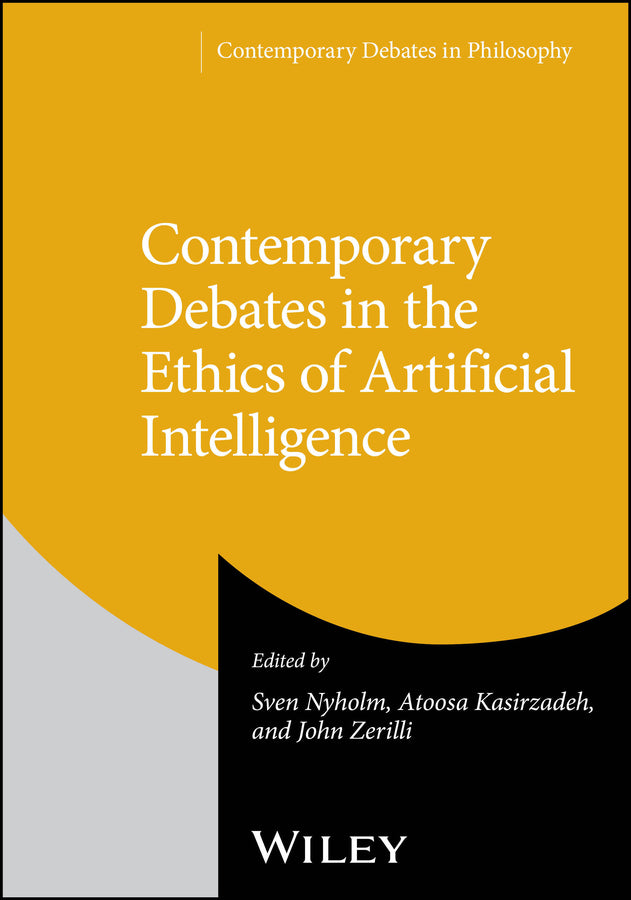
Contemporary Debates in the Ethics of Artificial Intelligence
Sven Nyholm (Edited by), Atoosa Kasirzadeh (Edited by), John Zerilli (Edited by)
9781394258819, Wiley
Paperback / softback, published 19 January 2026
496 pages
25.2 x 17.8 x 2.8 cm, 1.021 kg
"An up-to-date and accessible survey of contemporary scholarship that should inspire classroom debate and future research... this book should prove to be an excellent resource for both students and established scholars."
— Brendan Shea, Philosophy in Review
A cutting-edge selection of current issues and explorations of the ethics of artificial intelligence As artificial intelligence continues to influence virtually every facet of modern life, Contemporary Debates in the Ethics of Artificial Intelligence offers a timely and rigorous examination of the field's most pressing questions. Equally useful in the classroom or as a reference for interdisciplinary research, this volume fosters informed and critical engagement with the ethical dimensions of artificial intelligence in today's world. Curated by renowned scholars Sven Nyholm, Atoosa Kasirzadeh, and John Zerilli, Contemporary Debates in the Ethics of Artificial Intelligence brings together a dynamic mix of established leaders and emerging voices from both philosophy and computer science. The result is a uniquely structured collection of debates that not only introduces key concepts—such as agency, moral status, and value alignment—but also challenges readers to engage deeply with controversies around bias, transparency, and the societal risks posed by AI technologies. Providing frameworks for engaging responsibly with current and future AI technologies, Contemporary Debates in the Ethics of Artificial Intelligence: Contemporary Debates in the Ethics of Artificial Intelligence is ideal for undergraduate, advanced undergraduate, and graduate-level courses in philosophy, computer science, public policy, and related disciplines. It is well-suited for courses such as Ethics of Artificial Intelligence, Technology and Society, and Digital Ethics in philosophy, computer science, political science, international relations, and data science programs.
Notes on the Contributors ix Section One Conceptual and Methodological Preliminaries 1 Part 1 The Ethics of Defining Artificial Intelligence 3 1 What Is Artificial Intelligence and Should We Define It in Terms of Agency? 5 2 Artificial Intelligence as a New Form of Agency 17 Part 2 What Is Distinctive About the Ethics of AI? 35 3 What Can AI Ethics Learn from Medical Ethics, Bioethics, and Animal Ethics? 37 4 What Is Distinctive About AI Ethics When Compared to Bioethics? 51 Section Two Algorithmic Fairness and Explainability 61 Part 1 Algorithmic Fairness 63 5 Can We Make Algorithms Fair? 65 6 What If Algorithmic Fairness Is a Category Error? 77 Part 2 The Moral and Epistemological Significance of Explainability 97 7 Are Explanations of AI Decisions Morally Necessary? 99 8 Doing Without Explainable AI 111 Section Three Data and Privacy 121 Part 1 What Is Privacy in the Age of Artificial Intelligence and Why Is It Important? 123 9 Nine Philosophical Questions About Privacy 125 Part 2 Big Data and Group Rights 137 10 The Group Right to Privacy in the Age of AI 139 11 Group Rights: A Skeptical View 153 Section Four The Ethics of Handing over Tasks Previously Performed by Humans to AI 161 Part 1 Responsibility, Authorship, and Human Creativity in the Age of AI 163 12 Entangling Ourselves with AI: Affirmative Responsibility and the Cultivation of Responsible Agency 165 13 Generative AI, Language, and Authorship: Deconstructing the Debate and Moving It Forward 183 14 From “Can AI Be Creative?” to “What Is the Value of Integrating AI into Creative Processes?” 199 Part 2 AI and the Future of Work 213 15 What Will Work Be Like in the Future? 215 16 AI and the Future of Work: An Egalitarian Vision 229 Section Five Value Alignment, The Control Problem, and AI Risks 245 Part 1 Can We Solve the Value Alignment Problem? 247 17 What Would It Look Like to Align Humans with Ants? 249 Part 2 Could Value Alignment Guarantee Control over AI? 263 18 Could We Control Superintelligent AI? 265 19 The Many Faces of AI Alignment 277 Part 3 AI Ethics vs. AI Safety: Friends or Foes? 295 20 On the Troubled Relation Between AI Ethics and AI Safety 297 21 Short-Term or Long-Term AI Ethics? A Dilemma for Ethical Singularity Only 309 Section Six Can AI Technologies Be Sentient, and Should We Ever Treat Them with Moral Consideration? 319 Part 1 Can an AI Entity Be a Moral Patient? 321 22 Should We Worry About the Moral Status of Nonsentient AIs? 323 23 On the Moral Status of AI Entities and Robots: A Critique of the Social-Relational Approach and a Defense of the Properties-Based Approach 337 Section Seven Environmental Impacts and the Geopolitics of AI 353 Part 1 Where Should the Goal of Making AI Environmentally Sustainable Rank Among Attempts to Make Other Carbon-Intensive Activities Sustainable? 355 24 Reduce, Reuse, Recycle, Refuse: Green Data Refusal and Sustainable AI 357 Part 2 How Is AI Development Viewed by the Global Majority? 369 25 The Making and Management of Computational Agency 371 Section Eight Democracy and AI Governance 387 Part 1 Are AI-Powered Social Media Platforms Compatible with Democracy? 389 26 Deepfakes and Democracy 391 27 Should Online Platforms Be Publicly Owned and Controlled? 415 Part 2 AI Governance 427 28 The Tragedy of AI Governance 429 29 Can AI Be Governed? 439 Index 453
Acknowledgments xiii
Introduction xv
Sven Nyholm
Luciano Floridi
Paula Boddington
Thomas Grote
Margaret Mitchell
Arvind Narayanan
Emily Sullivan
David Danks
Leonhard Menges
Anuj Puri
John Zerilli
Fabio Tollon and Shannon Vallor
Mark Coeckelbergh and David Gunkel
Caterina Moruzzi
Daniel Susskind
Kate Vredenburgh
Vincent Conitzer
Roman V. Yampolskiy
Atoosa Kasirzadeh
Olle Häggström
Vincent C. Müller
Parisa Moosavi
John-Stewart Gordon
Cristina Richie
Ranjit Singh
Claire Benn
Sean Donahue
Simon Chesterman
Gillian K. Hadfield
Subject Areas: Society & culture: general [JF]