Freshly Printed - allow 10 days lead
Couldn't load pickup availability
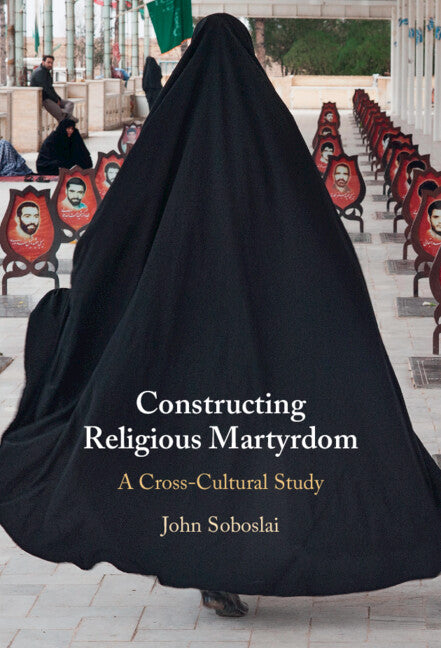
Constructing Religious Martyrdom
A Cross-Cultural Study
This study offers a new understanding of martyrdom across four religious traditions, analyzed through the lens of political theology.
John Soboslai (Author)
9781009483001, Cambridge University Press
Hardback, published 27 June 2024
458 pages
22.9 x 15.2 x 3 cm, 0.768 kg
Martyrdom is a phenomenon common to many of the world's religious traditions. But why? In this study, John Soboslai offers insights into the practices of self-sacrifice within specific sociopolitical contexts. Providing a new understanding of martyrdom through the lens of political theology, he analyzes discourses and performances in four religious traditions during social and political crises, beginning with second-century Christianity in Asia Minor, where the term 'martyr' first took its meaning. He also analyzes Shi'a Islam in the 1980s, when 'suicide bombing' first appeared as a strategy in West Asia; global Sikhism during World War I, where martyrs stood for and against the British Raj; and twenty-first-century Tibetan Buddhism, where self-immolators used their bodies in opposition to the programs of the People's Republic of China. Presenting a new theory of martyrdom linked to constructions of sovereign authority, Soboslai reveals common features of self-sacrifice and demonstrates how bodily performances buttress conceptions of authority.
1. Introduction: concerning martyrdom
2. Executed martyrs in second century Christianity
3. The human bombs of twentieth century Shi'i Islam
4. Sikh martyr imaginaries in the early twentieth century
5. The martyrdom of twenty-first century Tibetan self-immolators
6. Performances of suffering: The drama of martyrdom
7. Witnesses to a sovereign imaginary
Conclusion: The witness of martyrdom
Epilogue
Bibliography
Endnotes
Index.
Subject Areas: History of religion [HRAX]