Freshly Printed - allow 10 days lead
Couldn't load pickup availability
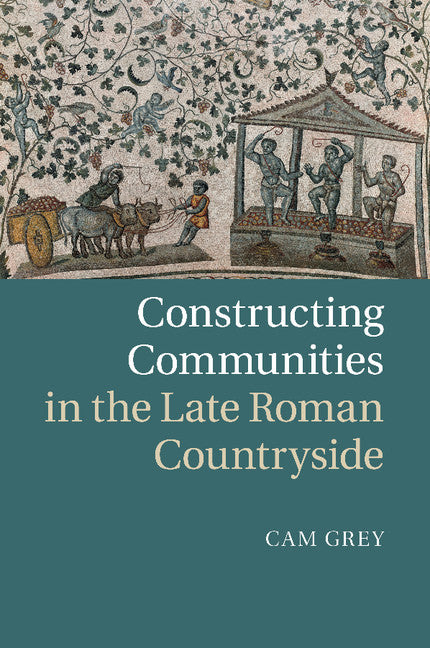
Constructing Communities in the Late Roman Countryside
The first comprehensive treatment of the 'small politics' of rural communities in the Late Roman world.
Cam Grey (Author)
9781107500013, Cambridge University Press
Paperback / softback, published 26 March 2015
284 pages, 1 map
23.1 x 15.4 x 1.7 cm, 0.434 kg
'In his absorbing new study … [Cam Grey] develops a supple and sophisticated theoretical framework within which to approach the sources that reveal late ancient peasant life. Grey's study is rich in important and compelling insights. Indeed, its great appeal is the fascinating and persuasive vision that it offers of peasants ably negotiating and even shaping a world that we are very much accustomed to view from the perspective of elite authors. It seeks to establish a new conceptual framework through which to approach the late ancient countryside; a framework which is both well-grounded in the sources and sympathetic to … the concerns and motivations of peasants, and which therefore helps us make good sense of the world that they inhabited. In this, it succeeds splendidly.' Jonathan P. Conant, Early Medieval Europe
This book is the first comprehensive treatment of the 'small politics' of rural communities in the Late Roman world. It places the diverse fates of those communities within a generalized model for exploring rural social systems. Fundamentally, social interactions in rural contexts in the period revolved around the desire of individual households to insure themselves against catastrophic subsistence failure and the need of the communities in which they lived to manage the attendant social tensions, inequalities and conflicts. A focus upon the politics of reputation in those communities provides a striking contrast to the picture painted by the legislation and the writings of Rome's literate elite: when viewed from the point of view of the peasantry, issues such as the Christianization of the countryside, the emergence of new types of patronage relations, and the effects of the new system of taxation upon rural social structures take on a different aspect.
Introduction: studying rural communities in the Late Roman world
1. Constituting communities: peasants, families, households
2. What really matters: risk, reciprocity, and reputation
3. Small politics: making decisions, managing tension, mediating conflict
4. Power as a competitive exercise: potentates and communities
5. Resistance, negotiation, and indifference: communities and potentates
6. Creating communities: taxation and collective responsibility
7. Unintended consequences: taxation, power, and communal conflict
Conclusions.
Subject Areas: Social & cultural history [HBTB], Ancient history: to c 500 CE [HBLA]