Freshly Printed - allow 10 days lead
Couldn't load pickup availability
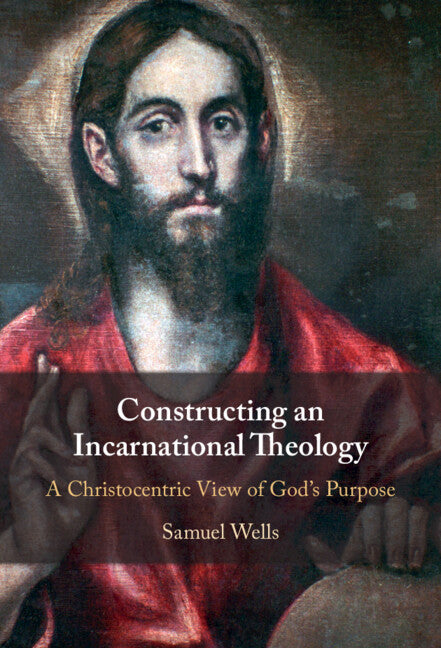
Constructing an Incarnational Theology
A Christocentric View of God's Purpose
Centres the reason for Christ's incarnation not in a theology of human scarcity but in one of divine abundance.
Samuel Wells (Author)
9781009492706, Cambridge University Press
Hardback, published 23 January 2025
320 pages
23.6 x 16 x 2.5 cm, 0.622 kg
'After a series of highly creative as well as influential books in ethics, ecclesiology, mission, and on pastoral concerns, in this theological study Sam Wells zooms in on what he considers the heart of it all: God's intention to be Jesus Christ, human beings to be with Jesus as his friends, and creation called into being as the theater of this friendship. For Wells, the incarnation is not simply God's response to sin, but God's first and fundamental commitment that holds all of creation together. Exegetically grounded, theologically reflective, and pastorally committed, this is a first order contribution to supralapsarian Christology. I am already looking forward to engage this book for a long time.' Edwin Chr. Van Driel, Pittsburgh Theological Seminary
Why did Jesus come? The traditional argument is that he came to redeem us from sin and destroy death, and thus reverse the fall. Many have long found this unsatisfactory, because it centres human deficit, rather than divine abundance. In this study, Samuel Wells traces his notion of 'being with' right into the Trinity itself, and in dialogue with Maximus the Confessor, Duns Scotus and Karl Barth, among others, articulates a truly Christocentric theology in which God's means and God's ends are identical. In the process, Wells not only greatly expands the compass of 'being with,' showing its scriptural and doctrinal significance, but also offers a constructive account of the incarnation, cross and resurrection of Jesus that out-narrates conventional atonement theories. Wells correspondingly proposes an account of sin, evil, suffering and death that accords with this revised understanding. The result is a compelling and transformational proposal in incarnational theology.
Introduction: making the story new
Part I. The Story of God: 1. An incarnational theology
2. The scriptural story
3. Being with God
Part II. An Emerging Story: 4. Medieval controversies
5. Orthodox explorations
6. Modern developments
Part III. Reconfiguring the Story: 7. God
8. God's purpose
9. God's unfolding purpose
10. God's unbreakable purpose
Conclusion: a wondrous story
Index.
Subject Areas: Theology [HRLB]