Freshly Printed - allow 10 days lead
Couldn't load pickup availability
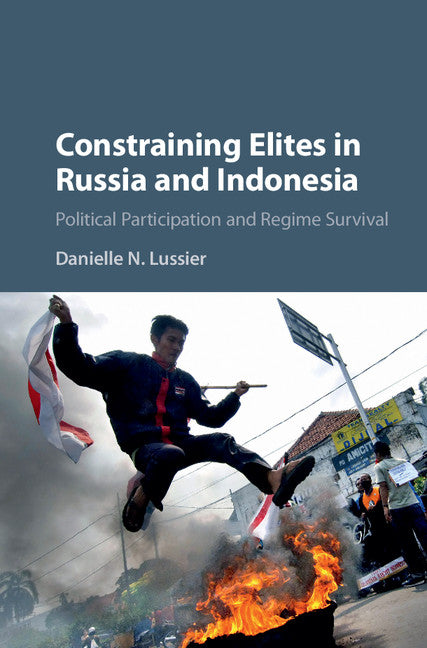
Constraining Elites in Russia and Indonesia
Political Participation and Regime Survival
This book studies why some democracies survive and others fail by examining the experiences of Russia and Indonesia.
Danielle N. Lussier (Author)
9781107084377, Cambridge University Press
Hardback, published 13 October 2016
332 pages, 6 b/w illus. 29 tables
22.9 x 15.2 x 2.2 cm, 0.66 kg
'This book represents a valuable contribution to the field of political science, offering a new perspective with well-elaborated concepts and in-depth historical analysis of countries. Moreover, it provides insights into the lives of ordinary citizens and reveals their values and views as relevant to democracy studies. Constraining Elites in Russia and Indonesia is an interesting and memorable piece of work, highly recommended not only for political scientists but everyone who is curious about the complex phenomenon of democracy.' Nanuli Silagadze, Europe-Asia Studies
This is a thought-provoking analysis on why democracy succeeds in some countries but not others, comparing the post-transition experiences of two cases of contemporary democratisation: Russia and Indonesia. Following authoritarian regimes, democracy eroded in Russia but flourished in Indonesia - so confounding dominant theories of democratisation that predicted the opposite outcomes based on their levels of socioeconomic development and histories of statehood. Identifying key behaviours and patterns of political participation as a factor, Lussier interweaves ethnographic interview and quantitative public opinion data to expand our understanding on how mass political participation contributes to a democracy's survival. The integration of both micro- and macro-level data in a single study is one of this project's most significant contributions, and will enhance its appeal to both researchers and instructors.
1. Introduction: activating democracy
2. Extending democratization theory: the cases of Russia and Indonesia
3. Elite-constraining participation and democracy's survival
4. Testing the model: predicting non-voting political participation
5. Tocqueville revisited: civic skills and social networks
6. Political efficacy and 'throwing the rascals out'
7. Political trust and regime legitimacy
8. Conclusion: political participation and the future of democracy.
Subject Areas: Comparative politics [JPB]