Freshly Printed - allow 8 days lead
Couldn't load pickup availability
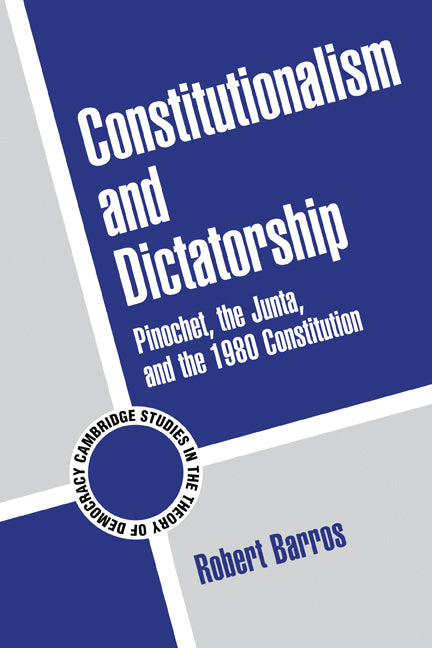
Constitutionalism and Dictatorship
Pinochet, the Junta, and the 1980 Constitution
It challenges long standing accepted wisdom about dictatorship and institutions.
Robert Barros (Author)
9780521796583, Cambridge University Press
Paperback, published 4 July 2002
368 pages, 8 tables
22.9 x 15.2 x 2.1 cm, 0.54 kg
'… an important contribution to debates about what happened in Chile under Pinochet, and raises new issues about the nature of absolute power … Barros has written a radical and bold reappraisal of established positions on the Pinochet regime … This book will be of great value to students who wish to understand more about the Chilean dictatorship but also as an introduction to theories of power and authoritarianism.' Latin American Review of Books
It is widely believed that autocratic regimes cannot limit their power through institutions of their own making. This book presents a surprising challenge to this view. It demonstrates that the Chilean armed forces were constrained by institutions of their own design. Based on extensive documentation of military decision-making, much of it long classified and unavailable, this book reconstructs the politics of institutions within the recent Chilean dictatorship (1973–1990). It examines the structuring of institutions at the apex of the military junta, the relationship of military rule with the prior constitution, the intra-military conflicts that led to the promulgation of the 1980 constitution, the logic of institutions contained in the new constitution, and how the constitution constrained the military junta after it went into force in 1981. This provocative account reveals the standard account of the dictatorship as a personalist regime with power concentrated in Pinochet to be grossly inaccurate.
1. Dictatorship, legality, and institutional constraints
2. The Constitution of the Exception: defining the rules of military rule
3. The constitution and the Dictatorship: The Supreme Court and the constitutionality of decree-laws
4. The shadowy boundary between force and law: the judiciary, repression, and the cosmetic limitation of emergency powers
5. Constitutionalization without transition: prompting the dual constitution of 1980
6. The permanent text: constitutional controls or military tutelage?
7. Even custom shoes bind: military rule under the constitution, 1981–1988
8. Military dictatorship and constitutionalism in Chile.
Subject Areas: Comparative law [LAM], Political economy [KCP], Politics & government [JP]