Freshly Printed - allow 10 days lead
Couldn't load pickup availability
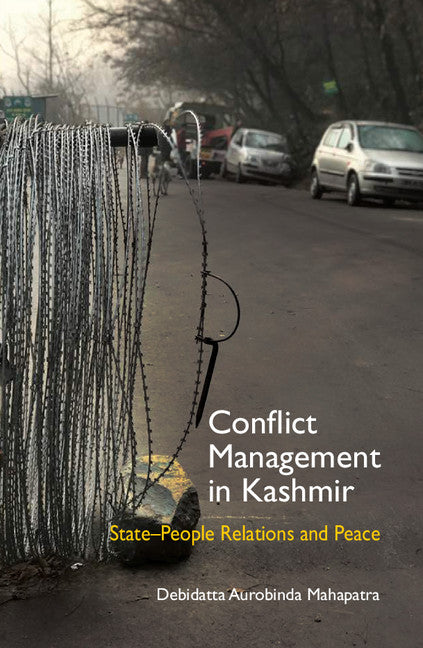
Conflict Management in Kashmir
State-People Relations and Peace
This work studies the world's most multifaceted and complex political turmoils - Kashmir, using the protracted social conflict theory.
Debidatta Aurobinda Mahapatra (Author)
9781108423892, Cambridge University Press
Hardback, published 24 November 2017
184 pages
23.5 x 15.8 x 1.6 cm, 0.37 kg
The book examines the intersections of political violence, deprivation and conflict, and explores the prospects of its management by studying one of the world's most complex political turmoils - Kashmir. It closely investigates the vertical aspect of the conflict, in which the Indian state and a section of Kashmiris are engaged in a turbulent relationship, and explores ways to stimulate conflict management. By employing the protracted social conflict theory, the author argues that a conflict between a state and a social group ensues when the political elite fail to address the non-material needs of the marginalized. By documenting narratives of the Kashmiri traders and the state officials, and the impact of the opening of the two intra-Kashmir trade routes during the 1990s, this book emphasizes the need to focus on peace initiatives taken by the government, and the significance of accommodation and engagement to address a state-people conflict.
Preface
1. Kashmir, conflict and the (uncomfortable?) questions
2. Theorizing conflicts
3. Protracted social conflict in Kashmir
4. Peace process, cross-border opening and the engagement
5. Traders' perspectives
6. Policy makers' perspective
7. Conflict management prospects
Select bibliography
Index.
Subject Areas: Regional government [JPR], Politics & government [JP], Sociology [JHB], Peace studies & conflict resolution [GTJ]